The Grass is Greener (1960)

Victor Rhyall, played by Cary Grant and his beautiful wife Lady Hilary Rhyall, played by Deborah Kerr, lead a quiet and steady life in a big estate inside a mansion.

Guided tours to the mansion were allowed to overcome their financial trouble. One such visit day, an oil tycoon Charles Delacro played by Robert Mitchum, visits the place and accidentally enters a private room of the Rhyalls.

Although Hilary tries to make him understand about the place being non-public, one can sense an attraction developing between the two by the conversations they indulge in. After some time, it is inevitable, Hilary is attracted to Charles, and both wonder how they go about it next.

Victor meets Charles, and they both familiarise themselves over a cup of tea. A few days later, Hilary makes up a reason to meet Charles. Aware of what’s happening, Victor remains an optimist about his love for his wife coming to his rescue.

After spending few days with Charles, Hilary is surprised to see Victor acting normal despite knowing everything about her. He invites Charles to his place for a night out and settle scores with him and win back his wife. Victor and Charles carry out a lot of funny tests with guns and at the pool table. It’s funny.

Hilary feels embarrassed over the entire situation, and her behaviour being the main reason for all the unwanted drama. The movie ends when she realises and apologises to Victor, thus ending the short-timed ‘Love Triangle.’

The Grass is Greener, released in 1960, was directed by Stanley Donen. This romantic comedy fared poorly at the box office despite having big stars on board.

This also was the third association of Cary Grant and Deborah Kerr pair, the previous two being An Affair to Remember and Dream Wife.

Jean Simmons plays Hilary’s friend and keeps the movie moving to believe it’s a quadrangular love story.

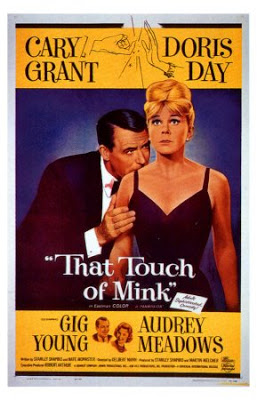
That Touch of Mink (1962)

Philip Shayne, a wealthy businessman, is a guy who possesses a lot of charm. This charm made Cathy Timberlake, an old fashioned country girl to go mad.

She has found the man of his dreams and cannot think of any other guy apart from him. Philip Shayne, played by Cary Grant, meets Cathy when his Rolls Royce splashes mud on her dress and later calls her up to apologise.

After apologising in the office, he is quite impressed by her honest heart. He decides to take her for his meetings, wherein she intervenes and, to his surprise, manages to convince the other members to negotiate a deal successfully.

Philip takes her out to a baseball match at the Yankees stadium. He owns a part of the team. We get to see baseball stars like ‘Yogi Berra,’ Mickey Mantle, and Roger Maris playing themselves getting thrown out for violating the rules.

Although Philip is very much interested in her, he has no plans of getting married, and there comes a clash because of her background. She believes in the traditional norms of getting married and start a family. In contrast, he is just looking for an affair.

After much persuasion, she finally agrees to go on a holiday trip to Bermuda with him. She develops a psychosomatic rash on her body, much to her disappointment and frustration.

To overcome the disappointment, she wants to repeat the Bermuda trip and hence reaches earlier than Philip. She drinks to calm her nerves, ends up drinking lots. When Philip arrives, he finds her in a drunken state, and she makes a fool of herself and to such an extent that she falls from the window. Dressed in pyjamas, she orders the hotel servicemen to take her to his room, while others her have a good laugh about it.

In the end, she finally manages to convince him to get married, and funnily in their honeymoon, he develops a rash.

This movie also happens to be the last movie, where Cary Grant persuades a girl. In his next film, Charade, Audrey Hepburn persuades him, as per Grant’s request, because of the 25 year age difference.

Released in 1962, That Touch of Mink was directed by Delbert Mann, was nominated for three Oscars in Best Art Direction, Best Sound, and Best Screenplay & Writing – directly for the screen categories.

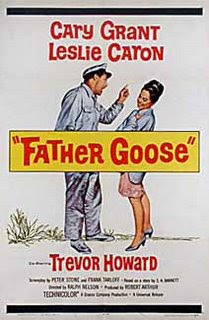
Father Goose (1964)

Walter Christopher Eckland, played by Cary Grant, is a vagrant who is living on a beach. During WWII, he is persuaded by the British Authorities to spy on the planes passing on the island. Reluctantly, he goes about his job. Commander Frank Houghton being an old friend of Mr. Eckland, it was a matter of obligation to be deserted on an island and spy.

During his stay on the island, he encounters a school teacher Catherine Freneau, played by Leslie Caron, stranded on the island and few children. They have managed to escape from the Japanese and thus seek shelter by taking Mr. Eckland’s help.

Mr. Eckland, as a result of a lady and kids, finds himself to be out of the house and finds shelter in his boat, which is semi-damaged.

The story involves a series of funny incidents between Mr. Eckland and Catherine over many issues. With time, they get each other’s perspective and start appreciating. Also, a change of attitude towards children is seen in Mr. Eckland as he takes up Catherine and the children’s responsibility.

He builds his boat so that it could be used to escape when the Japanese invade the island. Catherine and Mr. Eckland fall in love with each other and get married to the minister playing the priest’s role and perform the rituals via a radio transmitter. Japanese airplanes strike the island right after the wedding ritual.

While they wait for the submarine from the Navy to arrive, the Japanese invade the island. Mr. Eckland manages to distract the Japanese and escape safely.

Released in 1964, Father Goose was a romantic comedy directed by Ralph Nelson. It was nominated for three Oscars and won one Oscar for Best Screenplay, Writing. Other categories include Best Sound and Best Film Editing.

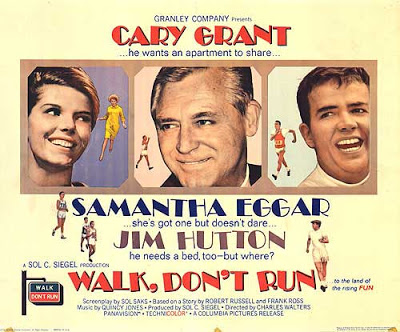
Walk Dont Run (1966)

The year of Olympics 1964, Sir William Rutland, played by Cary Grant, arrives in Tokyo a week before the Olympics. As a result of this, he finds himself in an awkward situation of the housing crisis.

He finally manages to find himself an Apartment occupied by Christine Easton, played by Samantha Eggar. Although she was looking for a woman, she finally agreed to let Sir William share the apartment.

Sir William meets American Olympian Steve Davies, who is also looking for a house to stay. He is offered to share with Sir William, much to the dismay of Christine. Steve Davies finds her very attractive and falls in love with her.

Hesitant in the beginning, but even Christine becomes closer to Steve. She is confused as she is engaged to the British diplomat Julius P Haversack, who also happens to be very dry and out of life, in short boring.

Sir William notices the closeness among these two and plays the role of cupid and brings them together. Cary Grant has some of the well written witty lines to offer in many scenes. This movie also marked the end of Cary Grant’s long movie career that spanned 34 years.

Quite strange to most Cary Grant movies in his entire career, this movie didn’t involve him romantically with a girl.

Directed by Charles Walters, released in 1966, Walk Don’t Run more vividly remembered as Cary Grant’s last movie and as a remake of 1943 classic ‘The More the Merrier’ starring Jean Arthur.

Topper (1937)

George Kerby, a wealthy businessman, played by Cary Grant, has a way to enjoy his life. His lifestyles are complimented by his wife Marion Kerby, played by Constance Bennett.

This life contrasts to that of Cosmo Topper, played by Roland Young, who leads a much planned and scheduled life. He is the chairman of a bank of which George is one of the board members.

Controlled mostly by his wife Clara, Cosmo Topper leads a life of mechanical routine, something he cannot change and is forced by his wife to dictate matters in every matter of his life.

George and Marion, fuelled by the energetic adrenaline, die in a car accident. To enter the passage of heaven, they must do some good deeds. So they are turned into ‘transparent ghosts.’

Topper is upset to hear the news of Kerby’s death. He buys the Kerby’s car and meets with an accident when excited by its speed, loses control of the vehicle. The Kerby couple introduces themselves to Cosmo. Cosmo Topper becomes a target to gain entry to heaven. Marion looks set to change Cosmo’s life.

A lot of laughs in the next part of the story, mainly the mess Cosmo Topper gets into because of the pranks played by Marion and George.

As a result of his newfound spontaneity, Cosmo’s popularity increases and attracts many social invitations.

The comical scenes are well shot throughout the movie. The hotel scene, lipstick mark on Cosmo’s cheek, Clara Topper gets annoyed with Cosmo’s new found lifestyle, Marion tempting Cosmo, Jealous George wanting to settle scores with Marion and Cosmo, the dog house detective scene, the car being driven with no driver and many more.

The movie culminates when Cosmo is getting treated in hospital after he meets with an accident. Clara promises him not to be dominant in the future. Kerby’s bid goodbye to Topper as they head towards the gates of heaven.

Released in 1937, Topper was adapted from a novel by ‘Thorne Smith,’ directed by Norman Z McLeod. This was the first black and white movie to be ‘colorized’ in 1985.

It earned two Oscar nominations – Roland Young for Best Supporting Actor and Best Sound Recording.

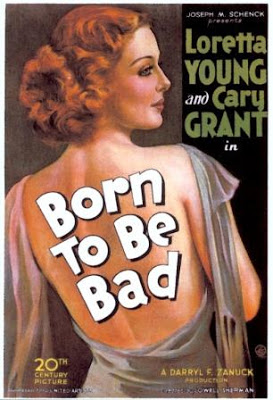
Born to be Bad (1934)

A young woman has got a raw deal from her youth, decides to leave her job at a book store searching for money, and becomes a night club dancer, more of a seductress.

She has a seven-year-old kid Mickey, whose father is unknown. She teaches Mickey to lie, steal, and all the things that would make him street smart. Apt to the title of the movie – Born to be Bad

Mickey has an accident when a truck driven by Malcolm Trevor, played by Cary Grant, knocks him down, not severely injured. Knowing Malcolm is rich, Letty, played by Loretta Young, schemes to make money by issuing a lawsuit against Malcolm. She is proven guilty for lying and accused of being a bad mother who taught her son to lie in court and fake his injury.

Mickey is taken away from her. Malcolm and his wife Alice happily accept to raise Mickey as they cannot conceive their child. With time, Mickey is attached to both of them, and this fact makes Letty jealous. She wants Mickey back and also some fortune of Malcolm’s.

She pretends to be sick and seeks refuge at Malcolm’s house when her plan of running away with Mickey fails. She seduces Malcolm and records the conversation to blackmail him. Her dreams turn sour when Malcolm tells Alice about him being in love with Letty, and she accepted it.

Letty learns a lesson in seeing Alice’s selfless love and decides Alice and Malcolm to have Mickey so that he becomes a good man. She returns to her old job at the book shop, and the movie ends there.

However, this movie had other claims to fame. It ran into censorship problems from the start because of skimpy outfits worn by Loretta Young. It was rejected twice by the censor board (Hays office). After several cuts and retakes, this movie was eventually passed and given an approval certificate.

Released in 1934, Born to be Bad was directed by Lowell Sherman.

Once Upon a Time (1944)

A showman Jerry Flynn has to find a new sensation to save his production from getting closed. He has a warning from the theatre owner to make matters worse. As he is looking out for a ‘sensation’ through which he can make money, he comes across a boy named ‘Pinky’ and discovers a dancing caterpillar ‘Curly’ with him.

Curly was not a usual caterpillar; it could dance. Looking at this, Jerry is convinced about the dancing caterpillar being the rescue agent.

The mean-minded that he is, he promises Pinky to make ‘Curly’ a superstar and Pinky agrees on one condition that, he wouldn’t be selling ‘Curly’ at any cost.

As he fights with Pinky’s elder sister, played by Janet Blair over this issue, Jerry secretly deals with Walt Disney after ‘Curly’ was perceived as a big jackpot.

The rest of the movie is a series of incidents that make ‘Curly’ very popular, much to Jerry Flynn’s delight, played by Cary Grant. ‘Curly’ had become so popular that one of the war planes was painted with Curly’s picture.

The controversy with the caterpillar and its ability to dance arouses a lot of attention with the scientists as they challenge to undermine the caterpillar’s ability.

Amidst events, Pinky becomes aware of Jerry’s intentions, and the movie culminates with Jerry understanding the kid’s sentiments and allows ‘Curly’ to have a life of its own.

Once Upon a Time, released in 1944, was a disaster due to its lousy screenplay. Directed by Alexander Hall, this movie failed to capture the minds of the audience.

The Howards of Virginia (1940)

Set in colonial Virginia in the 1750s, this movie is a story about Matt Howard and his wife Jane Howard when America was fighting for their independence.

Although there were cultural differences between Matt and Jane, there was no love lost between them when they kissed for the first time and fell in love.

Despite Jane’s brother opposing the marriage, they go through the ritual and raise a clutch of children. Their elder child’s lameness reminds Matt of his brother-in-law, and he manages to ignore the child for the very same fact.

The movie shows Matt, his friendship with Thomas Jefferson, and his unique portrayal of a farmer. In 1776, Matt enrolled to be part of George Washington’s army to fight for independence. In search of their father, Peyton and James, Matt and Jane’s sons decide to join the military. They meet their father.

Listening without being seen to his two sons arguing over the rebellion, he discovers Peyton to be the closest to his principles than his beloved James. He tries to communicate his love, but war comes in between.

The movie culminates in America getting Independence from British and George Washington becoming the First President of the United States.

The movie was commercially unsuccessful, and Cary Grant later confessed to him being miscast as Matt Howard.

Although the movie conveys the history of Virginia and the United States, there are few chronological errors. The costumes, however, have a period appeal to the 1750s.

The Howards of Virginia was directed by Frank Lloyd and earned two Oscar nominations for Best Music Original Score and Best Sound Recording.

The Last Outpost (1935)

Adapted from a novel by Britten Austin titled ‘The Drum,’ The Last Outpost featured two of the upcoming stars of the ’30s in Cary Grant and Claude Rains.

The movie is set during WWI when British officer Michael Andrews played by Cary Grant, is captured by a band of Kurdish raiders on the Eastern front and is rescued by a man who doesn’t reveal his name.

They both combined to avert an attack on British troops and also saved the civilians of Kurdish. Michael Andrews gets severely wounded and is sent for treatment to Cairo military camp.

He falls in love with the nurse Rosemary, played by Gertrude Michael and vice versa. Although married, she had not heard from her husband in the last three years.

When fit and alright, Michael Andrews is sent on a mission in Africa. After three long years, John Stevenson, played by Claude Rains, comes to claim his wife. John also happens to be the same guy who had saved Michael Andrews.

Rosemary tells John about her newfound love and is shocked to hear Michael being the one. John joins the troop of Michael to settle the scores.

The movie culminates in combining as a team to combat the enemies in the war while they resolve their differences.

Released in 1935, The Last Outpost was directed by Charles Barton and Louis J Gasnier.

Without Limits (1998)

Five days staying in a room not going out isn’t that great for the mind, body, or soul. I managed to do that. I went out to my friend’s place to have lunch, we chatted for a while, and then I went shopping for some groceries before heading back to The Apartment.

I spent those days watching movies, a hell of a lot of movies, reading few things on the internet, sleeping, just about cooking to satisfy the hunger bug, and few visits to the toilet. I had not touched the main door of my apartment. I managed to survive, although this routine had given birth to certain ghosts. It had because, I can safely say, I am burying them with this blog.

In 2005 when I won the Sports Quiz at NLS (National Law School, India), I missed a question. I felt terrible that I didn’t know about it. There is nothing to feel bad about it in hindsight, but you see, my heart was shaped that way.

It feels like the itch of not knowing certain things. For a while, it itches. The mind then takes over and I don’t know about the itch and how old it is. In my case, it was a four-year itch.

Thinking about the athlete whose name I missed has given me a chance to see life from a different perspective and something I was looking for at the end of 5 days. It was not a panache but did have some ‘Mojo’ to bury the ghosts. I feel the change as I continue to write.

The question I missed was about a man who died at the age of 24. I am 24 now.

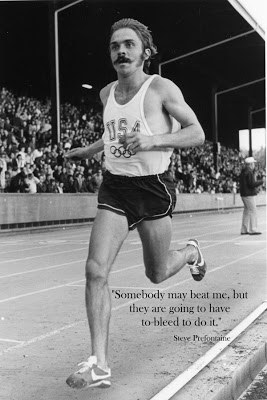
He was the best athlete the American distance running team had in the late ’60s and 1970s—a distance runner who had his ideology about running and winning.

Winning is nothing when you haven’t given your best.

It doesn’t feel the same when you win without giving one’s best. His coach tried to change his philosophy; he couldn’t. He represented the University of Oregon.

He shared a healthy relationship with the US running team coach, and they both agreed to disagree. Every time, they questioned each other’s fundamentals and philosophy of running and winning.

The first sign of protest came when the athlete took on AAU (Amateur Athletics Union) and demanded the athlete’s right to participate when qualified.

He was tipped as one of the favourites to win 5000m Olympic Gold in 1972 at Munich games, eventually losing out to Finland’s Lasse Viren. He finished 4th after leading the race till the last lap.

He couldn’t bear the loss.

He took some time out until he could come to terms with reality and distanced himself from his love. He hated so much that he didn’t have words to say to the one he loved.

Finally, he started training, refused an offer to turn professional, thereby kicking the chance to earn 200,000 dollars. He went to his coach and tried a new pair of shoes that his coach had made for him. He went for a run and agreed to be an Amateur and seek redemption at Montreal’s 1976 Olympics.

He raced pretty well in the trials, and he had planned to set a world record to win the 5000m in 12min 36 seconds. That was the time he had chosen, a world record back then.

Those were the last words he said to his friend. While on his way to his girlfriend, with whom he had just got good terms, he dropped his friend and met with an accident while foreseeing his race and commenting on his possible 1976 performance and how he would shatter the world record.

It wasn’t to be, his car was hit by another vehicle, and he was killed on May 30th, 1975.

I hope most of the readers are smarter than me; the athlete was Steve Pre Fontaine. Nicknamed ‘Pre,’ he was born on January 25th, 1951.

Now that name is on, I am sure there are better websites dedicated to providing his information in detail. I would just like to share few things:

  • In 1978, AAU agreed for athlete’s guarantee rights to compete wherever qualified.
  • The small shoe company which the coach had inadvertently had begun went on to became what we know today as ‘NIKE.’ The coach was none other than Bill Bowerman, founder of Nike.
  • ‘Without Limits’ made in 1998 is the movie’s name that depicts the life of ‘Pre’ played by Billy Crudup.

The final words by Bill Bowerman in the movie sums up ‘Pre’ –

“All my life, man and boy, I’ve operated under the assumption that the main idea in the running was to win the race. Naturally, when I became a coach, I tried to teach people how to do that. I tried to teach Pre how to do that. Tried like hell to teach Pre to do that. And Pre taught me. Taught me I was wrong. Pre, you see, was troubled by knowing that a mediocre effort can win a race, and a magnificent effort can lose one. Winning a race wouldn’t necessarily demand that he give it everything he had from start to finish. He never ran any other way. I tried to get him to; God knows I tried… but… Pre was stubborn. He insisted on holding himself to a higher standard than victory. ‘A race is a work of art’; that’s what he said, that’s what he believed, and he was out to make it one every step of the way. Of course, he wanted to win. Those who saw him compete and those who competed against him were never in any doubt how much he wanted to win, but how he won mattered to him more. ‘Pre’ thought I was a hard case. But he finally got it through my head that the real purpose of running isn’t to win a race. It’s to test the limits of the human heart. That he did… Nobody did it more often. Nobody did it better.” That’s the ending of the movie.

All I say – Watch the movie, don’t think whether to watch it or not – ‘JUST DO IT.’