Big Brown Eyes (1936)

Eve Fallon (Joan Bennett), upset for having not received the correct judgment that had political interference quits being a reporter and goes back to her other manicurist profession.

Her boyfriend, Danny Barr (Cary Grant), a detective who is equally upset with this injustice, quits the police. Now, they are secretly on their way to find the evidence. This movie had comedy, witty one-liners, romance, and mystery.

Eve comes across as a big mouth and has some of the best lines in the movie. Among frequent banters, Eve and Dan are very much in love. Dan is investigating a series of jewel robberies, and one of them turned severe with a baby being killed by a stray bullet.

The killer was identified, but the system had loopholes and wasn’t punished against the charges. In his way, Dan privately starts a trail on Cortig, as he is convinced about his involvement.

He gets support from Eve as she is always curious and in constant look for any news. While manicuring, she figures the role of a prominent personality’s involvement in the jewel robberies. The missing piece in Dan’s investigation is filled by the discovery made by Eve.

Richard Morey, a local politician, played by Walter Pidgeon, is the main man behind the crime, and he is nabbed by the teamwork of Eve and Dan. Comical performances by Marjorie Gateson in the role of Mrs. Chesley Cole and Douglas Fowley as Benny provide some exercise to the laughter muscles.

Released in 1936, Big Brown Eyes, directed by Raoul Walsh, was an experimental movie considering that this movie genre was limited to Warner Bros in the mid-1930s. Paramount managed to get the bearing with the story and the screenplay and was well accepted at the box office.

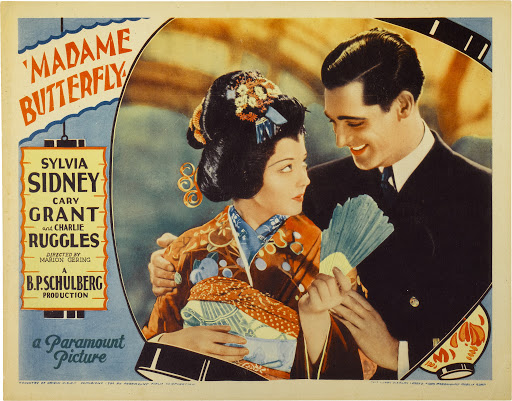
Madame Butterfly (1932)

Love has no boundaries, and it has no language. Madame Butterfly is one such story of different cultures and how one can get caught in the web of hope. The story is about lust on one side and love on the other.

Lieutenant Pinkerton (Cary Grant) arrives on the shore of Japan for a holiday. Lt Barton, his buddy, accompanies him to a local establishment to look out for food, drinks, and girls. Pinkerton gets attracted to the local muse Cho-Cho San (Sylvia Sidney).

Pinkerton is given Barton’s advice to marry Cho and enjoy her company with the family’s approval. Although not serious, he was concerned about what would happen to Cho once he leaves Japan.

Abandonment is considered equivalent to divorce in Japan. Barton stressed this point to Pinkerton, saying Cho will be free to marry any local guy once he abandons her and returns to America. Pinkerton marries Cho and spends few days at her place.

Cho’s mom and grandfather treat Pinkerton well. Cho is in love with him, and it was hard for her to accept that he will be away in a few days. With no promise, Cho waits for the return of Pinkerton. Three years pass by; she eagerly waits to meet her husband and give him a surprise, their son. She makes frequent visits to the harbour in the hope of seeing Pinkerton coming to meet her.

Pinkerton does arrive in Japan, along with his American bride. He meets Cho and tells the true story, and apologises to her. This admission by Pinkerton dashed the hope through which Cho lived for the past three years.

This is the story of Madame Butterfly. Paramount’s 1932 movie and directed by Marion Gering, was a non-singing version of the opera by the same name by Giacomo Puccini. The opera is based on the short story written by John Luther Long in 1898 and dramatised by David Belasco.

Gunga Din (1939)

Inspired by Rudyard Kipling’s poem, the movie is set in the mid-1800s when the British regiment had made a settlement in India. There were quite a few rebellious groups formed to eliminate the British rule, with resistance coming from all quarters.

This movie had one such group who revered Goddess Kali (an important deity in Hindu mythology, Goddess of Blood) dedicated their lives to destroy the British army.

The movie is about a Hindu water carrier called ‘Gunga Din.’ Since childhood, he always wanted to be in the army. He was not allowed, which never bothered him as he learned the military’s tricks by observing the soldiers.

He gets friendly with Sgt Cutter and also tells him about the gold which can be taken back from a Kali temple. Parallely, there is an uprising of a religious group under the leadership of Swami, played by Eduardo Ciannelli.

The group had previously attacked many such regiments at different villages, and now they had made arrangements to eliminate the British army in that area.

I am not comfortable using the technical word for such groups. Although in English and the movie, they are referred to as ‘Thuggees’, I will not use the name. During the British rule, it was the perception, and often such groups were branded as enemies and not seen as patriots.

From a movie’s point of view, I can only talk about performances on screen. The film talks about three army sergeants and the rapport they shared working together. Sgt Archibald Cutter (Cary Grant), Sgt Mac Chesney (Victor Mc Laglen), and Sgt Ballantine (Douglas Fairbank Jr) are fun-loving army personnel who love going on adventures together.

All was fine until one of them decides to leave the service to get married. In what is called a final mission, the two trick the soon to be groom to be a part of the troop.

In search of gold, Sgt Cutter and Gunga Din get trapped in a massive religious group gathering. As a part of the plan, Sgt Cutter surrenders to the group while instructing Gunga Din to inform his army troop about the place and situation.

Call it miscommunication; the two friends, along with Gunga Din, turn up at the temple. All are caught, and Gunga Din is branded as a traitor for helping the British. While in the temple, the three musketeers get to know the master plan of the rebellion to eliminate the entire British army.

The last part of the movie talks about Gunga Din’s gallantry, who risks his life to warn the British troops and manages to convey the message of the traps set by the rebellion.

On the other hand, it talks about the patriotism of Swami and his men, who are fighting for their freedom, for their country.

Although, the methods employed are violent, it wasn’t for fun. They had a purpose, and they went about in their way.

In a periodic movie to some extent, George Stevens displays his taste for humour showcases army staff enjoying a good laugh as they went about waging wars. Joan Fontaine plays the sole female in few scenes and fails to capture the audience in a bland role. Sam Jaffe in the title role impresses with his tailor-made acting of a Hindu water carrier.

“Tho’ I’ve belted you and flayed you, by the livin’ Gawd that made you, you’re a better man than I am, Gunga Din!” – Rudyard Kipling, last line of his highly acclaimed poem of the same name.

Released in 1939, RKO productions made this movie, which was the costliest at that time. Considering the war scenes and sets resembling rural India, the film was aptly nominated for an Oscar in the Best Cinematography Black and White category.

Kiss Them for Me (1957)

In my opinion, there was a void among war heroes as they battled day and night in places away from home. It was the call of duty more than a willingness to battle it out in a certain way.

While some of them took pride in fighting it out, many wanted the war to finish and return home. If the craving indeed gets worse, few men did take a chance to get back home while on duty. Kiss them For Me is a comical version of how three navy men, tired of war, want to when the war was on.

Cmdr Andy Crewson, played by Cary Grant, convinces his two colleagues to go away from a navy base. Homesickness coupled with being away from loved ones made them rusty to have such a runaway plot. They all land up in San Francisco, and with Lieutenant Wallace’s help, they manage to get a posh luxury suite in a famous hotel.

Andy manages to gather the party crowd, and all look like a great party time. Girls, alcohol, no war, life outside of being a navy pilot were better.

To maintain relations with top businessman, Wallace arranges for a meeting with Andy and the shipyard owner Eddie Turnbill. Turnbill wants to promote his warships and to increase and motivate his fellow workers, requested Andy and his two decorated pilots to give a small talk at his factory.

Andy refused and even embarrassed Eddie, but considering Eddie had good relations with the Admiral, he reversed his stand upon the insistence of his friends who convince him. Helping Eddie would allow their leaves extended without spending the ‘vacation’ in a navy hospital for check-ups.

While Turnbill is happy making plans for the talk, Andy sets his eyes on Eddie’s fiancée Gwinneth Livingston, played by the stunning Suzy Parker. Gwinneth, as evident from the first scene, is an epitome of an unhappy woman who requires a stable life.

Yet, in search of love, she isn’t entirely on good terms with Eddie’s relationship. It was as though love could blow away the relationship with Eddie. She ensures this point of hers is well expressed to Andy.

Instead of turning up and talk to labours, Andy decides to spend the night with Gwinneth and takes her out to a music bar and a restaurant. He was here to enjoy his vacation, not talk about the war.

Andy meets his old friends from the war, one handicapped, and gets to know he has few days left. He is in a strange mood, wondering he did the right thing running away from the action while many of his countrymen are fighting it out.

His two friends talk to labours on his behalf, and this didn’t go well with Eddie, fumingly tries to create a scene. Andy confronts Eddie and gives a blow instead of talking. Gwinneth breaks up with Eddie and joins Andy. Love is it.

Party time is over, guys, as Eddie turns up the heat and ensures the holiday is cancelled. In the meantime, Lt Mc Cann gets the ticket to join Congress, and he takes his two friends on board for this mission. The two friends get the call of war from inside; decide to join the navy instead. Mc Cann was not to be left behind; he gives up the ticket and joins his two friends.

In her role as Gwinneth, Suzy Parker makes her movie debut in an acting performance in a grand style. Previous was a cameo in the movie ‘Funny Face.’ Her beauty is the main strength in this movie, as her voice was given by another stunning actress of that era, Deborah Kerr.

A special mention of Jayne Mansfield makes a good impression and, in a significant way, imitates Monroe with her looks and talks. She is often mentioned as the poor man’s ‘Marilyn Monroe’ in reel and real life. Jayne’s character Alice Kratzner defines the title of the movie very aptly. In memory of her war husband in the film, he tells her, “Look me in all the war heroes and Kiss them for me.”

Famous for the song of the same name by The McGuire Sisters, this 1957 Stanley Donen directed movie is a good watch about war pilots’ back-stage lives.

Why History

I am browsing the site History.com; I ask myself a question. Why am I so fascinated with history? It’s indeed a thought-provoking question. In the most neutral sense, it means nothing but my preference over a gamut of topics we come across in daily life.

If I ask myself honestly at this moment, I can say; I love listening, watching, and telling stories. I love sports and movies. To stretch it a bit further, I love the historical journey of my favourites mentioned above in particular.

This doesn’t mean I do not like the present-day situation. To completely appreciate a particular concern in the present context, I want to know the history behind it.

Philosophically, this is how I look at life in general. ‘How I was’ is an essential connection to ‘How I am’ and a catalyst to ‘How I will be’; because in a short time, ‘How I am’ shall pass and becomes history in due course.

In that sense, history is essential, and it just gives an indication through which one can fathom how the trend has shaped over time.

Paying due respect to the ‘present moment,’ I say, the present choices that shape the future and come to the point of choice are dictated heavily by history.

Hence, in my opinion, history is a crucial element to know and to understand anything in general.

I have resources to learn history, but I feel we can do a lot more with history. History in some way is awareness, not entirely real if considered in the present context. It is a starter, sometimes more than an appetizer to make choices that would shape my future.

In the end, it is neither history nor astrology that define our lives…..

It is ‘Present.’ And the key element that connects ‘Present’ is history. Human life is all about being aware and ignorant at the same time. History helps us be knowledgeable and ignorant, depending on its relevance in our present life.

A whole mirror approach would similarly present the future studies. I choose and all these years chose history for several reasons unknown.

Sometimes in my journey, when I can connect more dots, I can refine and put it better as to why I like history.

I’m No Angel (1933)

There is a famous saying, “There is no business like show business.”

Mae West illustrates and depicts the role of a free-spirited ‘Tira’ in this 1933 movie, ‘I’m No Angel.’ Back then, she was already an established personality on screen, commanding immense respect among her peers in the industry.

Known for her witty one-liner and double entendres, Mae West stars in this movie in which she provides the story, screenplay, and dialogue.

To get out of a messy situation, Tira, in search of money, agrees to an offer to put her head into a lion’s mouth. The proposal was in New York and was a sell-out attraction. She attracted a lot of rich men.

A harbinger previously predicted her man of the future to be a rich guy with black hair. In search of this, she did socialise with men while explicitly going into the details specified by the fortune teller. Receiving presents through social gatherings from rich men was an everyday norm.

Jack Clayton, played by Cary Grant, tries to untie the infatuation of his friend with Tira. His friend was in a relationship, and to stop further embarrassment, Jack takes up convincing Tira to stop entertaining his friend. Along the way, Jack gets fascinated by Tira’s charm, and in turn, Tira feels she has found her man.

In her show business career, Tira made acquaintance with a lot of men; one such hopeless guy is Slick Wiley. He used to live on Tira’s money and never liked Tira getting close with rich men. When Jack and Tira decide to get married, Slick plays an evil trick on Jack’s claim that Tira was already married. The marriage is cancelled.

To get someone you love, one needs to fight certain circumstances. Tira acts as her attorney in court over a breach of promise suit. She questions the men from her past to prove her innocence. Misunderstanding is cleared, and finally, all hurdles are cleared.
Directed by Wesley Ruggles, this movie united Cary Grant and Mae West for the second and the last time together.

Sing as though no one’s listening

It is one of those days when you are in full song quite literally as you walk past the mild fog while humming the song that’s on the mind.

I do not intend to think much into why this is happening.

Strangely, I am beginning to like the winter and the coolness associated with it. It’s a pain waking up and accidentally touching one’s feet on the cold marble floor. It feels like walking on ice.

Trust me; in places where there is no provision for centralised heating, it can be quite an experience. But, that’s how it is, and you know, in the end, it’s an experience 🙂

After having a hot shower, I am making my breakfast, the feel of which would last few seconds, before the cool ambient air surrounds my body, and I run towards my wardrobe. I don’t run, but if I am walking on my barefoot, oh man, it is running time.

After a long time post-Delhi summer, it’s been layered clothing from past two to three weeks. It is good to see people experimenting with lots of combinations with their outfits.

In fact, I love watching others during winter. When I am walking, exchanging pleasantries is a nice feeling. When fully equipped in the clothes section, I love winters all the more.

Coming back to the singer in me, it is nice to walk around the streets and sing songs from inside.

Very oblivious to events around me, and all I am bothered is to enrich the experience and feel it completely.

In this regard, I love walking more than running because it is more rhythmic to my moods. I guess I haven’t mastered syncing the run with my spirits when compared with walking.

This is my assessment. Is this the feeling, “My Dil goes Hmmmm”? Well, I am trying to ask too many questions here, and I don’t feel like thinking about it…

This feeling was warmed with the hot mushroom soup which I had a few minutes ago.

A bonfire with a book is something ideal considering the fact; I am all by myself…

Well, things could be much better; but you don’t feel bad… It’s just one of those days when you are in this kind of mood.

One such mode where I am singing loud as though no one’s listening 🙂

Can you feel the song I am singing? Is that so good for you 🙂

The Bishop’s Wife (1947)

If there is one particular theme I like in movies, it is the theme of Christmas. Films with such a theme instill a sense of belief and give a lot of people some hope. Hope to lead life.

If it wasn’t through life, it was through movies that people found hope, and even today, films are widely considered a medium where people find hope.

After a long gap, Loretta Young (The Bishop’s Wife) shares the screen space with Cary Grant (Dudley). To be precise, their last movie together was Born to be Bad, released in 1934.

David Niven plays a bishop’s role, whose role is mainly limited to the ambiguity between the new cathedral’s funds, family, and principles.

Why is this movie special? Is it because it has Cary Grant playing one of the most refreshing roles of his life?

Cary Grant, in his role as Dudley, plays the character of an angel. An angel who sometimes resembles our inner voice. In this chaotic world, one hardly listens to our inner voice; since it’s an opinion or a thought restricted to ourselves.

But when a feel-good thought comes from others’ suggestions, we usually pick it up and apply them on a higher percentage scale.

In short, people who are optimistic about their lives listen to such suggestions and go about leading their lives catalysed by such thoughts or ideas.

Even if it is for a short time, it is the jump start one needs to refresh and get out of crossroads. Professor, The Bishop’s wife, Mrs. Hamilton, and few others are the ones who had lost hopes in their respective lives, and an angel restored the same.

Dudley says, “Angel can be anyone on the street. Someone you don’t know but can bring in a lot of change in the way we would like to lead our lives.”

The other side of the coin, cynicism, exists as displayed by the Bishop, who refuses to believe in miracles, though being the almighty’s mortal messenger. He was adamant about building the cathedral; he even went to the extent of compromising his principles to raise funds.

His real prayers (raising funds) were finally answered, though not in a way he wanted. But who would question the method of an angel? The Bishop certainly did but didn’t succeed in overpowering the methods.

Dudley, the angel, spends most of his time with Julia, the Bishop’s wife, and their kid Debby, yet manages to answer the Bishop’s prayers. Strange method indeed.

The problem of funds was never looked at, and this movie epitomises true human nature emphasising the importance of winning over someone’s heart to get what we truly want.

Dudley won the heart of Mrs. Hamilton, who finally relented to the angel’s advice and decided to shed her ego. Donating her money, she helps the Bishop build his dream, the cathedral, which would provide shelter to the needy.

Dudley had to leave once the prayers were answered, but it was tough as he was attached to Bishop’s wife, cursed himself for being an angel; as he realised being an immortal, it was impossible to beat a mortal to win over a mortal’s heart.

Directed by Henry Koster, this 1947 movie was nominated in five different categories, including Best Picture, and it did manage to win one for the Best Sound Recording.

Me and my thoughts

I must say, I had a sort of eventful weekend and it was all by myself. I am not sure how it feels for many people, but from what I have seen and heard, it is clear that we are ourselves when we are left with our thoughts and choices.

After a long hiatus, I managed to watch the golden classics of the Hollywood era. In short, I got a chance to watch movies on my laptop. This year I managed to catch up with many Hindi films with my housemates from South Delhi.

Now that guys have gone to their respective stop-gap arrangements, I have moved into a new house; last week, I moved into another house, just a few metres away. It feels different, with cold feet and in a place with no heaters. Yes, it has its fun. After going through a record-breaking Delhi summer, I am getting to feel, what the locals say, the best part of Delhi, it’s winter.

The fog will take some time to make its appearance. I have seen them in many Bollywood movies; it sure would feel good walking when fog prevails over Delhi.

Cooking, well, I have been very sporadic in this regard but still managed to cook quite a lot. I like when there are people around me. It brings the chef in me to the fore. Anyway, it’s an excellent way to experiment with new dishes. And it is always better to try first before letting others taste them.

Over the past week, running against the cool breeze gave me a good feeling. Running is a good thing, and more than running, I fancy brisk walking where I get a chance to talk to myself, and it’s more rhythmic to the thoughts that come to my mind. One such idea was – “If you compare yourself with others, you are a socialite; if you compare yourself with your past, you are a genius.”

I came up with this line, and the next moment, I wondered, what could be the meaning of this. I thought over the line mentioned above; I didn’t feel the same because I was fabricating a theory to support this line.

Well, I tried again, thinking, what if others ask. Still, I wasn’t convinced, or should say, didn’t have any convincing reason to support my line. In the end, after pondering close to ten minutes, I decided to stick with the line without any reason. Whom should I reason with? I feel good with this line, and I am sure I will find the motivation along the way. This, in my opinion, is the way it should be.

Indeed, it’s an intuitive call.