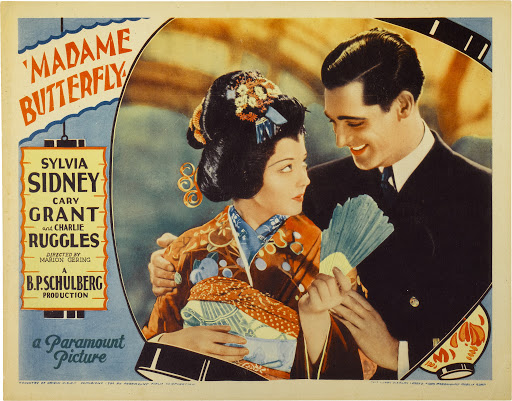
Madame Butterfly (1932)

Love has no boundaries, and it has no language. Madame Butterfly is one such story of different cultures and how one can get caught in the web of hope. The story is about lust on one side and love on the other.

Lieutenant Pinkerton (Cary Grant) arrives on the shore of Japan for a holiday. Lt Barton, his buddy, accompanies him to a local establishment to look out for food, drinks, and girls. Pinkerton gets attracted to the local muse Cho-Cho San (Sylvia Sidney).

Pinkerton is given Barton’s advice to marry Cho and enjoy her company with the family’s approval. Although not serious, he was concerned about what would happen to Cho once he leaves Japan.

Abandonment is considered equivalent to divorce in Japan. Barton stressed this point to Pinkerton, saying Cho will be free to marry any local guy once he abandons her and returns to America. Pinkerton marries Cho and spends few days at her place.

Cho’s mom and grandfather treat Pinkerton well. Cho is in love with him, and it was hard for her to accept that he will be away in a few days. With no promise, Cho waits for the return of Pinkerton. Three years pass by; she eagerly waits to meet her husband and give him a surprise, their son. She makes frequent visits to the harbour in the hope of seeing Pinkerton coming to meet her.

Pinkerton does arrive in Japan, along with his American bride. He meets Cho and tells the true story, and apologises to her. This admission by Pinkerton dashed the hope through which Cho lived for the past three years.

This is the story of Madame Butterfly. Paramount’s 1932 movie and directed by Marion Gering, was a non-singing version of the opera by the same name by Giacomo Puccini. The opera is based on the short story written by John Luther Long in 1898 and dramatised by David Belasco.

Gunga Din (1939)

Inspired by Rudyard Kipling’s poem, the movie is set in the mid-1800s when the British regiment had made a settlement in India. There were quite a few rebellious groups formed to eliminate the British rule, with resistance coming from all quarters.

This movie had one such group who revered Goddess Kali (an important deity in Hindu mythology, Goddess of Blood) dedicated their lives to destroy the British army.

The movie is about a Hindu water carrier called ‘Gunga Din.’ Since childhood, he always wanted to be in the army. He was not allowed, which never bothered him as he learned the military’s tricks by observing the soldiers.

He gets friendly with Sgt Cutter and also tells him about the gold which can be taken back from a Kali temple. Parallely, there is an uprising of a religious group under the leadership of Swami, played by Eduardo Ciannelli.

The group had previously attacked many such regiments at different villages, and now they had made arrangements to eliminate the British army in that area.

I am not comfortable using the technical word for such groups. Although in English and the movie, they are referred to as ‘Thuggees’, I will not use the name. During the British rule, it was the perception, and often such groups were branded as enemies and not seen as patriots.

From a movie’s point of view, I can only talk about performances on screen. The film talks about three army sergeants and the rapport they shared working together. Sgt Archibald Cutter (Cary Grant), Sgt Mac Chesney (Victor Mc Laglen), and Sgt Ballantine (Douglas Fairbank Jr) are fun-loving army personnel who love going on adventures together.

All was fine until one of them decides to leave the service to get married. In what is called a final mission, the two trick the soon to be groom to be a part of the troop.

In search of gold, Sgt Cutter and Gunga Din get trapped in a massive religious group gathering. As a part of the plan, Sgt Cutter surrenders to the group while instructing Gunga Din to inform his army troop about the place and situation.

Call it miscommunication; the two friends, along with Gunga Din, turn up at the temple. All are caught, and Gunga Din is branded as a traitor for helping the British. While in the temple, the three musketeers get to know the master plan of the rebellion to eliminate the entire British army.

The last part of the movie talks about Gunga Din’s gallantry, who risks his life to warn the British troops and manages to convey the message of the traps set by the rebellion.

On the other hand, it talks about the patriotism of Swami and his men, who are fighting for their freedom, for their country.

Although, the methods employed are violent, it wasn’t for fun. They had a purpose, and they went about in their way.

In a periodic movie to some extent, George Stevens displays his taste for humour showcases army staff enjoying a good laugh as they went about waging wars. Joan Fontaine plays the sole female in few scenes and fails to capture the audience in a bland role. Sam Jaffe in the title role impresses with his tailor-made acting of a Hindu water carrier.

“Tho’ I’ve belted you and flayed you, by the livin’ Gawd that made you, you’re a better man than I am, Gunga Din!” – Rudyard Kipling, last line of his highly acclaimed poem of the same name.

Released in 1939, RKO productions made this movie, which was the costliest at that time. Considering the war scenes and sets resembling rural India, the film was aptly nominated for an Oscar in the Best Cinematography Black and White category.

Kiss Them for Me (1957)

In my opinion, there was a void among war heroes as they battled day and night in places away from home. It was the call of duty more than a willingness to battle it out in a certain way.

While some of them took pride in fighting it out, many wanted the war to finish and return home. If the craving indeed gets worse, few men did take a chance to get back home while on duty. Kiss them For Me is a comical version of how three navy men, tired of war, want to when the war was on.

Cmdr Andy Crewson, played by Cary Grant, convinces his two colleagues to go away from a navy base. Homesickness coupled with being away from loved ones made them rusty to have such a runaway plot. They all land up in San Francisco, and with Lieutenant Wallace’s help, they manage to get a posh luxury suite in a famous hotel.

Andy manages to gather the party crowd, and all look like a great party time. Girls, alcohol, no war, life outside of being a navy pilot were better.

To maintain relations with top businessman, Wallace arranges for a meeting with Andy and the shipyard owner Eddie Turnbill. Turnbill wants to promote his warships and to increase and motivate his fellow workers, requested Andy and his two decorated pilots to give a small talk at his factory.

Andy refused and even embarrassed Eddie, but considering Eddie had good relations with the Admiral, he reversed his stand upon the insistence of his friends who convince him. Helping Eddie would allow their leaves extended without spending the ‘vacation’ in a navy hospital for check-ups.

While Turnbill is happy making plans for the talk, Andy sets his eyes on Eddie’s fiancée Gwinneth Livingston, played by the stunning Suzy Parker. Gwinneth, as evident from the first scene, is an epitome of an unhappy woman who requires a stable life.

Yet, in search of love, she isn’t entirely on good terms with Eddie’s relationship. It was as though love could blow away the relationship with Eddie. She ensures this point of hers is well expressed to Andy.

Instead of turning up and talk to labours, Andy decides to spend the night with Gwinneth and takes her out to a music bar and a restaurant. He was here to enjoy his vacation, not talk about the war.

Andy meets his old friends from the war, one handicapped, and gets to know he has few days left. He is in a strange mood, wondering he did the right thing running away from the action while many of his countrymen are fighting it out.

His two friends talk to labours on his behalf, and this didn’t go well with Eddie, fumingly tries to create a scene. Andy confronts Eddie and gives a blow instead of talking. Gwinneth breaks up with Eddie and joins Andy. Love is it.

Party time is over, guys, as Eddie turns up the heat and ensures the holiday is cancelled. In the meantime, Lt Mc Cann gets the ticket to join Congress, and he takes his two friends on board for this mission. The two friends get the call of war from inside; decide to join the navy instead. Mc Cann was not to be left behind; he gives up the ticket and joins his two friends.

In her role as Gwinneth, Suzy Parker makes her movie debut in an acting performance in a grand style. Previous was a cameo in the movie ‘Funny Face.’ Her beauty is the main strength in this movie, as her voice was given by another stunning actress of that era, Deborah Kerr.

A special mention of Jayne Mansfield makes a good impression and, in a significant way, imitates Monroe with her looks and talks. She is often mentioned as the poor man’s ‘Marilyn Monroe’ in reel and real life. Jayne’s character Alice Kratzner defines the title of the movie very aptly. In memory of her war husband in the film, he tells her, “Look me in all the war heroes and Kiss them for me.”

Famous for the song of the same name by The McGuire Sisters, this 1957 Stanley Donen directed movie is a good watch about war pilots’ back-stage lives.

I’m No Angel (1933)

There is a famous saying, “There is no business like show business.”

Mae West illustrates and depicts the role of a free-spirited ‘Tira’ in this 1933 movie, ‘I’m No Angel.’ Back then, she was already an established personality on screen, commanding immense respect among her peers in the industry.

Known for her witty one-liner and double entendres, Mae West stars in this movie in which she provides the story, screenplay, and dialogue.

To get out of a messy situation, Tira, in search of money, agrees to an offer to put her head into a lion’s mouth. The proposal was in New York and was a sell-out attraction. She attracted a lot of rich men.

A harbinger previously predicted her man of the future to be a rich guy with black hair. In search of this, she did socialise with men while explicitly going into the details specified by the fortune teller. Receiving presents through social gatherings from rich men was an everyday norm.

Jack Clayton, played by Cary Grant, tries to untie the infatuation of his friend with Tira. His friend was in a relationship, and to stop further embarrassment, Jack takes up convincing Tira to stop entertaining his friend. Along the way, Jack gets fascinated by Tira’s charm, and in turn, Tira feels she has found her man.

In her show business career, Tira made acquaintance with a lot of men; one such hopeless guy is Slick Wiley. He used to live on Tira’s money and never liked Tira getting close with rich men. When Jack and Tira decide to get married, Slick plays an evil trick on Jack’s claim that Tira was already married. The marriage is cancelled.

To get someone you love, one needs to fight certain circumstances. Tira acts as her attorney in court over a breach of promise suit. She questions the men from her past to prove her innocence. Misunderstanding is cleared, and finally, all hurdles are cleared.
Directed by Wesley Ruggles, this movie united Cary Grant and Mae West for the second and the last time together.

The Bishop’s Wife (1947)

If there is one particular theme I like in movies, it is the theme of Christmas. Films with such a theme instill a sense of belief and give a lot of people some hope. Hope to lead life.

If it wasn’t through life, it was through movies that people found hope, and even today, films are widely considered a medium where people find hope.

After a long gap, Loretta Young (The Bishop’s Wife) shares the screen space with Cary Grant (Dudley). To be precise, their last movie together was Born to be Bad, released in 1934.

David Niven plays a bishop’s role, whose role is mainly limited to the ambiguity between the new cathedral’s funds, family, and principles.

Why is this movie special? Is it because it has Cary Grant playing one of the most refreshing roles of his life?

Cary Grant, in his role as Dudley, plays the character of an angel. An angel who sometimes resembles our inner voice. In this chaotic world, one hardly listens to our inner voice; since it’s an opinion or a thought restricted to ourselves.

But when a feel-good thought comes from others’ suggestions, we usually pick it up and apply them on a higher percentage scale.

In short, people who are optimistic about their lives listen to such suggestions and go about leading their lives catalysed by such thoughts or ideas.

Even if it is for a short time, it is the jump start one needs to refresh and get out of crossroads. Professor, The Bishop’s wife, Mrs. Hamilton, and few others are the ones who had lost hopes in their respective lives, and an angel restored the same.

Dudley says, “Angel can be anyone on the street. Someone you don’t know but can bring in a lot of change in the way we would like to lead our lives.”

The other side of the coin, cynicism, exists as displayed by the Bishop, who refuses to believe in miracles, though being the almighty’s mortal messenger. He was adamant about building the cathedral; he even went to the extent of compromising his principles to raise funds.

His real prayers (raising funds) were finally answered, though not in a way he wanted. But who would question the method of an angel? The Bishop certainly did but didn’t succeed in overpowering the methods.

Dudley, the angel, spends most of his time with Julia, the Bishop’s wife, and their kid Debby, yet manages to answer the Bishop’s prayers. Strange method indeed.

The problem of funds was never looked at, and this movie epitomises true human nature emphasising the importance of winning over someone’s heart to get what we truly want.

Dudley won the heart of Mrs. Hamilton, who finally relented to the angel’s advice and decided to shed her ego. Donating her money, she helps the Bishop build his dream, the cathedral, which would provide shelter to the needy.

Dudley had to leave once the prayers were answered, but it was tough as he was attached to Bishop’s wife, cursed himself for being an angel; as he realised being an immortal, it was impossible to beat a mortal to win over a mortal’s heart.

Directed by Henry Koster, this 1947 movie was nominated in five different categories, including Best Picture, and it did manage to win one for the Best Sound Recording.

The Grass is Greener (1960)

Victor Rhyall, played by Cary Grant and his beautiful wife Lady Hilary Rhyall, played by Deborah Kerr, lead a quiet and steady life in a big estate inside a mansion.

Guided tours to the mansion were allowed to overcome their financial trouble. One such visit day, an oil tycoon Charles Delacro played by Robert Mitchum, visits the place and accidentally enters a private room of the Rhyalls.

Although Hilary tries to make him understand about the place being non-public, one can sense an attraction developing between the two by the conversations they indulge in. After some time, it is inevitable, Hilary is attracted to Charles, and both wonder how they go about it next.

Victor meets Charles, and they both familiarise themselves over a cup of tea. A few days later, Hilary makes up a reason to meet Charles. Aware of what’s happening, Victor remains an optimist about his love for his wife coming to his rescue.

After spending few days with Charles, Hilary is surprised to see Victor acting normal despite knowing everything about her. He invites Charles to his place for a night out and settle scores with him and win back his wife. Victor and Charles carry out a lot of funny tests with guns and at the pool table. It’s funny.

Hilary feels embarrassed over the entire situation, and her behaviour being the main reason for all the unwanted drama. The movie ends when she realises and apologises to Victor, thus ending the short-timed ‘Love Triangle.’

The Grass is Greener, released in 1960, was directed by Stanley Donen. This romantic comedy fared poorly at the box office despite having big stars on board.

This also was the third association of Cary Grant and Deborah Kerr pair, the previous two being An Affair to Remember and Dream Wife.

Jean Simmons plays Hilary’s friend and keeps the movie moving to believe it’s a quadrangular love story.

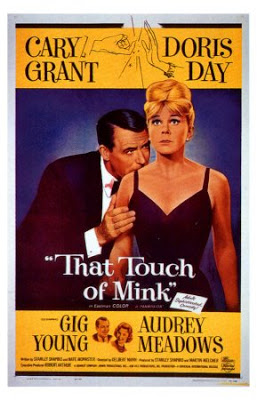
That Touch of Mink (1962)

Philip Shayne, a wealthy businessman, is a guy who possesses a lot of charm. This charm made Cathy Timberlake, an old fashioned country girl to go mad.

She has found the man of his dreams and cannot think of any other guy apart from him. Philip Shayne, played by Cary Grant, meets Cathy when his Rolls Royce splashes mud on her dress and later calls her up to apologise.

After apologising in the office, he is quite impressed by her honest heart. He decides to take her for his meetings, wherein she intervenes and, to his surprise, manages to convince the other members to negotiate a deal successfully.

Philip takes her out to a baseball match at the Yankees stadium. He owns a part of the team. We get to see baseball stars like ‘Yogi Berra,’ Mickey Mantle, and Roger Maris playing themselves getting thrown out for violating the rules.

Although Philip is very much interested in her, he has no plans of getting married, and there comes a clash because of her background. She believes in the traditional norms of getting married and start a family. In contrast, he is just looking for an affair.

After much persuasion, she finally agrees to go on a holiday trip to Bermuda with him. She develops a psychosomatic rash on her body, much to her disappointment and frustration.

To overcome the disappointment, she wants to repeat the Bermuda trip and hence reaches earlier than Philip. She drinks to calm her nerves, ends up drinking lots. When Philip arrives, he finds her in a drunken state, and she makes a fool of herself and to such an extent that she falls from the window. Dressed in pyjamas, she orders the hotel servicemen to take her to his room, while others her have a good laugh about it.

In the end, she finally manages to convince him to get married, and funnily in their honeymoon, he develops a rash.

This movie also happens to be the last movie, where Cary Grant persuades a girl. In his next film, Charade, Audrey Hepburn persuades him, as per Grant’s request, because of the 25 year age difference.

Released in 1962, That Touch of Mink was directed by Delbert Mann, was nominated for three Oscars in Best Art Direction, Best Sound, and Best Screenplay & Writing – directly for the screen categories.

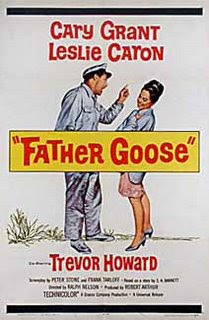
Father Goose (1964)

Walter Christopher Eckland, played by Cary Grant, is a vagrant who is living on a beach. During WWII, he is persuaded by the British Authorities to spy on the planes passing on the island. Reluctantly, he goes about his job. Commander Frank Houghton being an old friend of Mr. Eckland, it was a matter of obligation to be deserted on an island and spy.

During his stay on the island, he encounters a school teacher Catherine Freneau, played by Leslie Caron, stranded on the island and few children. They have managed to escape from the Japanese and thus seek shelter by taking Mr. Eckland’s help.

Mr. Eckland, as a result of a lady and kids, finds himself to be out of the house and finds shelter in his boat, which is semi-damaged.

The story involves a series of funny incidents between Mr. Eckland and Catherine over many issues. With time, they get each other’s perspective and start appreciating. Also, a change of attitude towards children is seen in Mr. Eckland as he takes up Catherine and the children’s responsibility.

He builds his boat so that it could be used to escape when the Japanese invade the island. Catherine and Mr. Eckland fall in love with each other and get married to the minister playing the priest’s role and perform the rituals via a radio transmitter. Japanese airplanes strike the island right after the wedding ritual.

While they wait for the submarine from the Navy to arrive, the Japanese invade the island. Mr. Eckland manages to distract the Japanese and escape safely.

Released in 1964, Father Goose was a romantic comedy directed by Ralph Nelson. It was nominated for three Oscars and won one Oscar for Best Screenplay, Writing. Other categories include Best Sound and Best Film Editing.

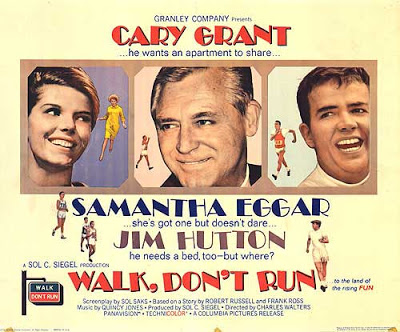
Walk Dont Run (1966)

The year of Olympics 1964, Sir William Rutland, played by Cary Grant, arrives in Tokyo a week before the Olympics. As a result of this, he finds himself in an awkward situation of the housing crisis.

He finally manages to find himself an Apartment occupied by Christine Easton, played by Samantha Eggar. Although she was looking for a woman, she finally agreed to let Sir William share the apartment.

Sir William meets American Olympian Steve Davies, who is also looking for a house to stay. He is offered to share with Sir William, much to the dismay of Christine. Steve Davies finds her very attractive and falls in love with her.

Hesitant in the beginning, but even Christine becomes closer to Steve. She is confused as she is engaged to the British diplomat Julius P Haversack, who also happens to be very dry and out of life, in short boring.

Sir William notices the closeness among these two and plays the role of cupid and brings them together. Cary Grant has some of the well written witty lines to offer in many scenes. This movie also marked the end of Cary Grant’s long movie career that spanned 34 years.

Quite strange to most Cary Grant movies in his entire career, this movie didn’t involve him romantically with a girl.

Directed by Charles Walters, released in 1966, Walk Don’t Run more vividly remembered as Cary Grant’s last movie and as a remake of 1943 classic ‘The More the Merrier’ starring Jean Arthur.

Topper (1937)

George Kerby, a wealthy businessman, played by Cary Grant, has a way to enjoy his life. His lifestyles are complimented by his wife Marion Kerby, played by Constance Bennett.

This life contrasts to that of Cosmo Topper, played by Roland Young, who leads a much planned and scheduled life. He is the chairman of a bank of which George is one of the board members.

Controlled mostly by his wife Clara, Cosmo Topper leads a life of mechanical routine, something he cannot change and is forced by his wife to dictate matters in every matter of his life.

George and Marion, fuelled by the energetic adrenaline, die in a car accident. To enter the passage of heaven, they must do some good deeds. So they are turned into ‘transparent ghosts.’

Topper is upset to hear the news of Kerby’s death. He buys the Kerby’s car and meets with an accident when excited by its speed, loses control of the vehicle. The Kerby couple introduces themselves to Cosmo. Cosmo Topper becomes a target to gain entry to heaven. Marion looks set to change Cosmo’s life.

A lot of laughs in the next part of the story, mainly the mess Cosmo Topper gets into because of the pranks played by Marion and George.

As a result of his newfound spontaneity, Cosmo’s popularity increases and attracts many social invitations.

The comical scenes are well shot throughout the movie. The hotel scene, lipstick mark on Cosmo’s cheek, Clara Topper gets annoyed with Cosmo’s new found lifestyle, Marion tempting Cosmo, Jealous George wanting to settle scores with Marion and Cosmo, the dog house detective scene, the car being driven with no driver and many more.

The movie culminates when Cosmo is getting treated in hospital after he meets with an accident. Clara promises him not to be dominant in the future. Kerby’s bid goodbye to Topper as they head towards the gates of heaven.

Released in 1937, Topper was adapted from a novel by ‘Thorne Smith,’ directed by Norman Z McLeod. This was the first black and white movie to be ‘colorized’ in 1985.

It earned two Oscar nominations – Roland Young for Best Supporting Actor and Best Sound Recording.