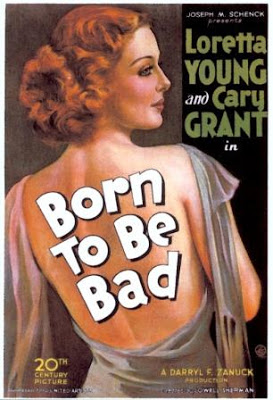
Born to be Bad (1934)

A young woman has got a raw deal from her youth, decides to leave her job at a book store searching for money, and becomes a night club dancer, more of a seductress.

She has a seven-year-old kid Mickey, whose father is unknown. She teaches Mickey to lie, steal, and all the things that would make him street smart. Apt to the title of the movie – Born to be Bad

Mickey has an accident when a truck driven by Malcolm Trevor, played by Cary Grant, knocks him down, not severely injured. Knowing Malcolm is rich, Letty, played by Loretta Young, schemes to make money by issuing a lawsuit against Malcolm. She is proven guilty for lying and accused of being a bad mother who taught her son to lie in court and fake his injury.

Mickey is taken away from her. Malcolm and his wife Alice happily accept to raise Mickey as they cannot conceive their child. With time, Mickey is attached to both of them, and this fact makes Letty jealous. She wants Mickey back and also some fortune of Malcolm’s.

She pretends to be sick and seeks refuge at Malcolm’s house when her plan of running away with Mickey fails. She seduces Malcolm and records the conversation to blackmail him. Her dreams turn sour when Malcolm tells Alice about him being in love with Letty, and she accepted it.

Letty learns a lesson in seeing Alice’s selfless love and decides Alice and Malcolm to have Mickey so that he becomes a good man. She returns to her old job at the book shop, and the movie ends there.

However, this movie had other claims to fame. It ran into censorship problems from the start because of skimpy outfits worn by Loretta Young. It was rejected twice by the censor board (Hays office). After several cuts and retakes, this movie was eventually passed and given an approval certificate.

Released in 1934, Born to be Bad was directed by Lowell Sherman.

Once Upon a Time (1944)

A showman Jerry Flynn has to find a new sensation to save his production from getting closed. He has a warning from the theatre owner to make matters worse. As he is looking out for a ‘sensation’ through which he can make money, he comes across a boy named ‘Pinky’ and discovers a dancing caterpillar ‘Curly’ with him.

Curly was not a usual caterpillar; it could dance. Looking at this, Jerry is convinced about the dancing caterpillar being the rescue agent.

The mean-minded that he is, he promises Pinky to make ‘Curly’ a superstar and Pinky agrees on one condition that, he wouldn’t be selling ‘Curly’ at any cost.

As he fights with Pinky’s elder sister, played by Janet Blair over this issue, Jerry secretly deals with Walt Disney after ‘Curly’ was perceived as a big jackpot.

The rest of the movie is a series of incidents that make ‘Curly’ very popular, much to Jerry Flynn’s delight, played by Cary Grant. ‘Curly’ had become so popular that one of the war planes was painted with Curly’s picture.

The controversy with the caterpillar and its ability to dance arouses a lot of attention with the scientists as they challenge to undermine the caterpillar’s ability.

Amidst events, Pinky becomes aware of Jerry’s intentions, and the movie culminates with Jerry understanding the kid’s sentiments and allows ‘Curly’ to have a life of its own.

Once Upon a Time, released in 1944, was a disaster due to its lousy screenplay. Directed by Alexander Hall, this movie failed to capture the minds of the audience.

The Howards of Virginia (1940)

Set in colonial Virginia in the 1750s, this movie is a story about Matt Howard and his wife Jane Howard when America was fighting for their independence.

Although there were cultural differences between Matt and Jane, there was no love lost between them when they kissed for the first time and fell in love.

Despite Jane’s brother opposing the marriage, they go through the ritual and raise a clutch of children. Their elder child’s lameness reminds Matt of his brother-in-law, and he manages to ignore the child for the very same fact.

The movie shows Matt, his friendship with Thomas Jefferson, and his unique portrayal of a farmer. In 1776, Matt enrolled to be part of George Washington’s army to fight for independence. In search of their father, Peyton and James, Matt and Jane’s sons decide to join the military. They meet their father.

Listening without being seen to his two sons arguing over the rebellion, he discovers Peyton to be the closest to his principles than his beloved James. He tries to communicate his love, but war comes in between.

The movie culminates in America getting Independence from British and George Washington becoming the First President of the United States.

The movie was commercially unsuccessful, and Cary Grant later confessed to him being miscast as Matt Howard.

Although the movie conveys the history of Virginia and the United States, there are few chronological errors. The costumes, however, have a period appeal to the 1750s.

The Howards of Virginia was directed by Frank Lloyd and earned two Oscar nominations for Best Music Original Score and Best Sound Recording.

The Last Outpost (1935)

Adapted from a novel by Britten Austin titled ‘The Drum,’ The Last Outpost featured two of the upcoming stars of the ’30s in Cary Grant and Claude Rains.

The movie is set during WWI when British officer Michael Andrews played by Cary Grant, is captured by a band of Kurdish raiders on the Eastern front and is rescued by a man who doesn’t reveal his name.

They both combined to avert an attack on British troops and also saved the civilians of Kurdish. Michael Andrews gets severely wounded and is sent for treatment to Cairo military camp.

He falls in love with the nurse Rosemary, played by Gertrude Michael and vice versa. Although married, she had not heard from her husband in the last three years.

When fit and alright, Michael Andrews is sent on a mission in Africa. After three long years, John Stevenson, played by Claude Rains, comes to claim his wife. John also happens to be the same guy who had saved Michael Andrews.

Rosemary tells John about her newfound love and is shocked to hear Michael being the one. John joins the troop of Michael to settle the scores.

The movie culminates in combining as a team to combat the enemies in the war while they resolve their differences.

Released in 1935, The Last Outpost was directed by Charles Barton and Louis J Gasnier.

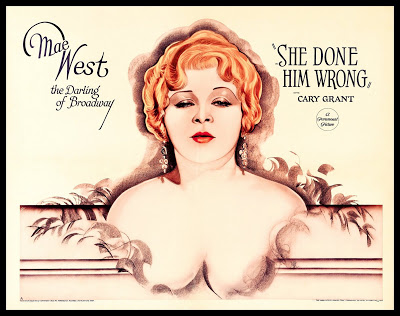
She Done Him Wrong (1933)

Mae West playing the role of Lady Lou is a nightclub owner in New York. One can imagine a lady of that stature to have many friends. She had more male friends than one can imagine.

The movie involves various scenes inside the night club and how few males try their luck to impress ‘Lady Lou.’

Although Captain Cummings is in no mood to embrace her, she does find his liking. One of Lady Lou’s lines – “Why don’t you come up and see me sometime?” is one of the best lines considered by many film critics and been voted in the Top 100 lines in many movie sites.

This movie was more focussed on Mae West, who proved why she was one of the best in the business of ‘comical sexuality.’

After this movie, The Nation legion of Decency was formed in 1933, stating the film and Mae West be one of the prime reasons.

The movie showcases the pride of the character ‘Lady Lou’ who, endowed with jewels, hip swishing, proclaims to the public, ‘I am the finest woman who walked the streets.’

Captain Cummings, played by Cary Grant, warns her about the consequences because of her attitude, and it is he who helps her at the end of the movie.

This movie is based on Mae West’s play titled ‘Diamond Lil’ in the late 1920s.

In his early years of acting, Cary Grant plays second fiddle to the more renowned Mae West. Paramount Productions hired him, and this movie saved Paramount Pictures from bankruptcy, and they owe it to Mae West and her popularity at that time.

Released in 1933, She Done Him Wrong was directed by Lowell Sherman and was the shortest movie in duration (66 minutes) to receive a Best Picture Oscar. Besides, it is the only movie (at the time of writing this post) to be nominated Best Picture category without nominations in other categories.

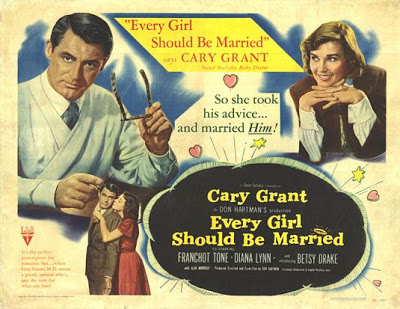
Every Girl Should Be Married (1948)

‘Every Girl Should be married,’ is what Dr. Madison Brown says. Anabel Sims, played by Betsy Drake, takes the advice and goes about searching for a perfect husband.

Dr. Madison Brown, played by Cary Grant, plays a reputed paediatrician. He is a noted bachelor too.

Anabel Sims is determined to find Mr. Right finds Dr. Madison very apt as her perfect husband. The movie involves a series of plots in which she stalks Dr. Madison.

She plays the role of a department store salesclerk; when Dr. Madison asks for her help to purchase few things, she decides him to be the one.

She finds all possible information about him, routines, and whereabouts. Knowing her intentions, Dr. Madison tries his best to fend off her.

She uses the help of Roger Sanford, who is a thrice-married playboy. It so happens, Roger falls in love with Anabel. She uses this to tease Dr. Madison and make him feel jealous. All of them turn out to be unsuccessful.

After a series of funny plots and dialogues, the movie culminates when Dr. Madison knows of Roger’s success with a woman and tries to stop them from getting married.

While waiting for Anabel at her place, Old Joe, long-time hometown beau of Anabel, unexpectedly. In the end, Dr. Madison does ask her hand for marriage.

Released in 1948, this movie directed by Don Hartman was one of the highest grosser of 1948.

This romantic comedy is hilarious, and Cary Grant proves his mettle with his sheer comic timing. A pretty Betsy Drake plays a role of a stalker literally.

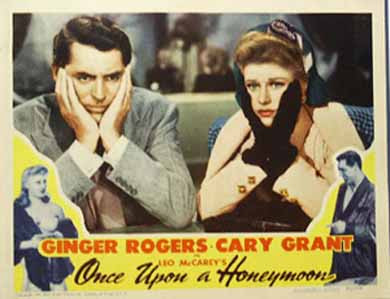
Once Upon a Honeymoon (1942)

During the time of WWII, many American reporters were deputed in Europe to narrate the war. This is a story of an American radio reporter Pat ‘O’ Toole, played by Cary Grant, his various adventures across Europe while covering the war. American burlesque Katie ‘O’ Hara marries an Austrian millionaire Baron Von Luber for her social climbing. Pat sees this marriage as an opportunity to expose the alleged, suspected ties of Baron with the Nazis.

Pat is after a story as he follows Katie and Baron on their honeymoon across many European countries. One can see country after country falling under the Nazi regime penned by Baron’s involvement.

Pat falls in love with Katie. Upon realising her husband’s role with Nazis, she escapes from the Baron by faking her death. When the Nazi regime had strengthened its hold in Europe, Katie, owing to her patriotic obligations, decides to don the role of a spy and goes back to Baron.

The final scene exposes the foolishness of Baron and the Nazi regime when Pat, upon agreement with Baron, delivers a radio speech to the public quite contrary to what was agreed upon.

This movie represents the typical Cary Grant, playing his comic – serious, eligible bachelor roles. Pretty looking, Ginger Rogers does justice to her role with her range of facial expressions and demonstrates her acting skills.

Look out for most actors’ comic timing as this film turned out to be just an entertainer. Keeping the mood of the early 1940s in America, this movie turns out to be another way of looking at WWII from an American perspective.

Released in 1942, Leo McCarey directs this comical adventure nominated for Best Oscar for sound recording.

The Roaring Twenties (1939)

‘The Roaring Twenties’ refers to the period post-WWI and the events during the 1920s in North America and other parts of Europe.

The recession hit America is not able to find jobs for the war veterans who return from Europe. Eddie Bartlett, George Hally, and Llyod Hart meet and become friends towards the war’s end.

Jean Sherman, played by Priscilla Lane, becomes a big fan of Eddie Bartlett for his heroics at war and sends him her photograph and letters during his stay in Europe.

Upon return to America, they find jobs hard to secure. Llyod Hart goes to practice law. George Hally, played by Humphrey Bogart, enters into bootlegging. The same would be Eddie Bartlett’s path, who becomes one of the members to have a bootleg business.

American prohibition law at that time prevented the manufacture, selling, import, and export of liquor. So this was taken as an opportunity to trade alcohol illegally.

He builds a fleet of cabs by selling bootleg liquors and hires Llyod Hart as his lawyer.

Eddie helps Jean Sherman to get a job in a speakeasy run by Panama Smith. Eddie is in love with Jean, and she is under obligation because of all the favours done to him.

The plot thickens when George becomes the partner and sets about killing the rival gang to regain supremacy.

Love debacle when it becomes clear that Jean Sherman and Llyod Hart are in love, his breakout with George and subsequent fall of share market doesn’t go well with Eddie. He spends some time in prison for his activities.

Eddie starts afresh by driving a cab, meets Jean Sherman after few years. Llyod Hart, happily married to Jean Sherman, has a home, a kid and a good work position. His life is under threat since Llyod is out to enforce specific legal laws that would ruin his business.

The final part is one of the defining moments when Jean Sherman asks Eddie to save her family. Eddie and George are having a confrontation resulting in gunshots and both being dead.

The character of Eddie Bartlett is inspired by the life and career of bootlegger Larry Fay. This movie also turned out to be one of the last action films James Cagney featured in before he set out to venture into other character roles.

Released in 1939, The Roaring Twenties was directed by Raoul Walsh. Look out for scenes where Humphrey Bogart and James Cagney share the space. It’s a viewer’s delight.

Suspicion (1941)

Travelling on a first-class compartment with a third-class ticket, Johnny Asgarth, played by Cary Grant, meets the shy Lina Mclindlaw essayed by Joan Fontaine. She is beauty personified, and Johnny uses every trick in the book to court her.

She comes from a wealthy background, a factor that drew Johnny towards Lina. Since no way she had to elope, her father, played by Sir Cedric Hardwicke, would approve their marriage. After a fantastic honeymoon, she discovers the mess Johnny is in. She feared for their future due to his reckless attitude and constant gambling tendencies.

Each time she feared, he used to calm her down with his charm. He was broke and in desperate need of money and engrossed himself reading many murder mysteries.

He had a good friend in Beaky, who did have money, and they had made plans to start a business. Beaky dies under mysterious circumstances, and Lina suspects her husband to have played a role in it. Her suspicion overrules her senses to an extent where she feels the tag of being the next target. She suspects Johnny to kill her and take the money from her insurance.

Her state of mind could be summed up with a scene where Johnny gets her a glass of milk. Interestingly, the scene is shot strangely. He holds the milk glass, which is glowing, and Lina feels the milk to be poisoned.

Fearing for her life, she decides to leave to her mother’s place, and Johnny hesitantly insists he would drive her.

(DISCLAIMER)

The movie’s highlight and probably the best scene are the last one as they drive along the road, with Johnny speeding up the car and moving close to the cliffs. Lina anxiously and fearfully expects her death, watches Johnny take a shortcut, and finds her door opened. He lends his hand to close the door; she feels he is trying to push her out. In the end, he manages to drag her back and stops the car.

He questions her behaviour and clarifies; he didn’t murder Beaky. Instead, he was reading murder mysteries to commit suicide as he was ashamed of his inability to pay off the debts and face prison.

As Lina, Joan Fontaine impresses with her acting skills, charm, and elegance in this movie. Cary Grant plays the role where there is love in the heart and trouble in his mind. A cameo from Alfred Hitchcock, where he is seen posting a letter in a post office scene.

This movie’s ending was altered to keep Cary Grant’s heroic image he had with the audience.

This film marked the first instance of Alfred Hitchcock producing and directing a movie. This also happens to be the only time he has directed an actor to an Oscar-winning performance. Joan Fontaine won the Oscar for Best Actress.

Besides, it was also nominated for Best Picture and Best Music.

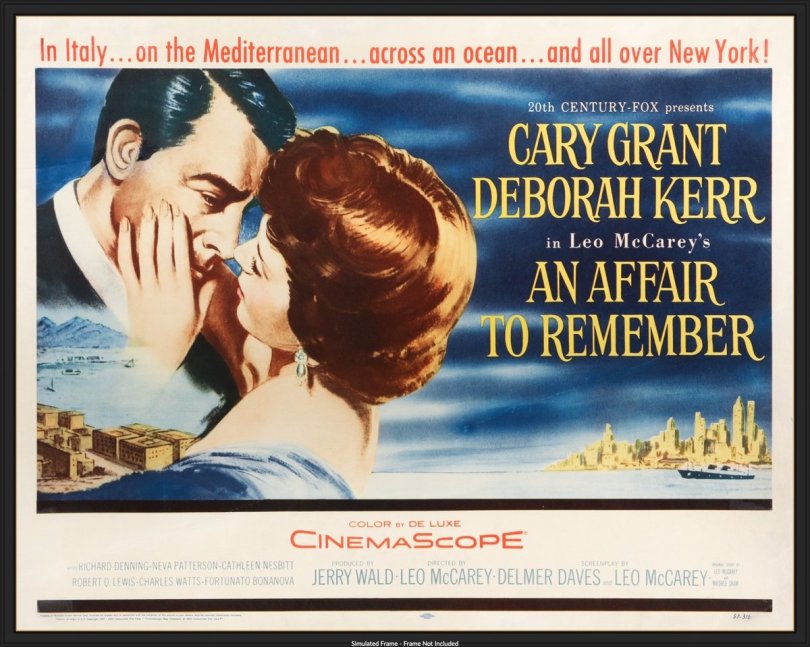
An Affair To Remember (1957)

What happens when a handsome playboy meets the gorgeous night club singer on a cruise. The first part of this Leo McCarey’s classic ‘An Affair to Remember’ showcases the above scenario. Cary Grant as Nickie Ferrante plays the playboy, and Deborah Kerr plays the dashing Terry Mckay.

Despite both being engaged, they couldn’t help themselves falling in love with each other on the ship and make a promise to meet after six months at The Empire State Building.

With engagements being on hold, both wait for six months to see each other on the building’s 102nd floor. A perfect story in progress until Debroah Kerr meets with an accident right on the day of the visit. Cary Grant striding to and fro on the 102nd floor, can only console himself. He waits the entire day and wonders why till the end of the movie.

Whether they would get married would remain unanswered, and accident becomes the reason that prevents the reunion of the couple.

The story was quite a drama back then, not the same as when it was made in Hindi in 1999. One can copy the theme, not the entire storyline and scene settings. ‘Mann’ starring Aamir Khan and Manisha Koirala, failed because it couldn’t connect to the so-called “modern-time” and not compelling content. Times change, hence individual perceptions on love change. Unfortunately, Mann wasn’t able to accommodate this change.

The highlights are the scenes shot in a garden mansion where Cary Grant takes Deborah Kerr to meet her grandmother. Their love blossomed at the very place. The last scene is a memorable one when Cary Grants holds Deborah Kerr.

This movie is a remake of the 1939 film ‘Love Affair’ starring Irene Dunne and Charles Boyer. Leo McCarey directed both.

An Affair to Remember was nominated for four Oscars in the Best Music, Best Costume, Best Song, and Best Cinematography categories.