The Howards of Virginia (1940)

Set in colonial Virginia in the 1750s, this movie is a story about Matt Howard and his wife Jane Howard when America was fighting for their independence.

Although there were cultural differences between Matt and Jane, there was no love lost between them when they kissed for the first time and fell in love.

Despite Jane’s brother opposing the marriage, they go through the ritual and raise a clutch of children. Their elder child’s lameness reminds Matt of his brother-in-law, and he manages to ignore the child for the very same fact.

The movie shows Matt, his friendship with Thomas Jefferson, and his unique portrayal of a farmer. In 1776, Matt enrolled to be part of George Washington’s army to fight for independence. In search of their father, Peyton and James, Matt and Jane’s sons decide to join the military. They meet their father.

Listening without being seen to his two sons arguing over the rebellion, he discovers Peyton to be the closest to his principles than his beloved James. He tries to communicate his love, but war comes in between.

The movie culminates in America getting Independence from British and George Washington becoming the First President of the United States.

The movie was commercially unsuccessful, and Cary Grant later confessed to him being miscast as Matt Howard.

Although the movie conveys the history of Virginia and the United States, there are few chronological errors. The costumes, however, have a period appeal to the 1750s.

The Howards of Virginia was directed by Frank Lloyd and earned two Oscar nominations for Best Music Original Score and Best Sound Recording.
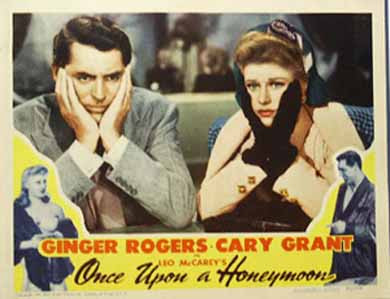
Once Upon a Honeymoon (1942)

During the time of WWII, many American reporters were deputed in Europe to narrate the war. This is a story of an American radio reporter Pat ‘O’ Toole, played by Cary Grant, his various adventures across Europe while covering the war. American burlesque Katie ‘O’ Hara marries an Austrian millionaire Baron Von Luber for her social climbing. Pat sees this marriage as an opportunity to expose the alleged, suspected ties of Baron with the Nazis.

Pat is after a story as he follows Katie and Baron on their honeymoon across many European countries. One can see country after country falling under the Nazi regime penned by Baron’s involvement.

Pat falls in love with Katie. Upon realising her husband’s role with Nazis, she escapes from the Baron by faking her death. When the Nazi regime had strengthened its hold in Europe, Katie, owing to her patriotic obligations, decides to don the role of a spy and goes back to Baron.

The final scene exposes the foolishness of Baron and the Nazi regime when Pat, upon agreement with Baron, delivers a radio speech to the public quite contrary to what was agreed upon.

This movie represents the typical Cary Grant, playing his comic – serious, eligible bachelor roles. Pretty looking, Ginger Rogers does justice to her role with her range of facial expressions and demonstrates her acting skills.

Look out for most actors’ comic timing as this film turned out to be just an entertainer. Keeping the mood of the early 1940s in America, this movie turns out to be another way of looking at WWII from an American perspective.

Released in 1942, Leo McCarey directs this comical adventure nominated for Best Oscar for sound recording.