SAME TALE FOR DIFFERENT TIMES: THE TEN COMMANDMENTS (1956) AND EXODUS (2014)

I imagine being in a place where I can see the present and the origins of the past. I can see civilizations, the mighty empires of the yore, and the developed metropolis of today. I can see the science of our ancestors and the technology of the present. While there are many points of change, there is one which I believe has stood the test of time -people and their interpretations of various beliefs.

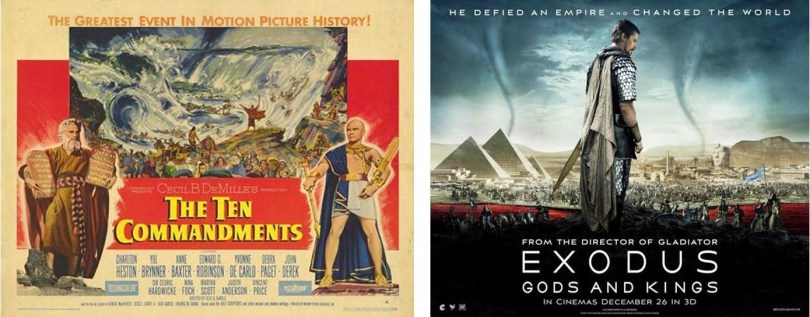
In this premise, I look at the epic Cecile DeMille’s The Ten Commandments (1956) and the recently released ‘Exodus: Gods and Kings’ (2014).

Both take on the same topic – the story of freedom of ‘Hebrews’ from the bondage of the Egyptian rulers, same backdrop, same characters, and a similar conclusion; yet the treatment is miles apart.

In the case of DeMille, going by his strong interest in religion and his inclination towards complex scripting gives us the most accurate narration based on what has been written on the matter.

In contrast, the 2014 movie does justice to what the current generation would be more inclined to believe.

CECILE VERSION

What is history? It is a record of what had happened, written by people who have witnessed or have recorded from other sources. While it narrates, it fails to give us a 360° approach on any matter. Take Moses’s story; books have been written based on evidence that has been unearthed so far.

Who can validate the veracity of events that were recorded? The more we dwell on this matter, the more skewed the analysis. Instead, it is well acknowledged; evidence serves us a basis to comment on a topic, narrate, and in this case, make movies on screen.

It is fascinating to see that our ways of looking at history have evolved immensely in less than sixty years. I arrive at this from the way movies have been scripted.

If you go back in time to 1923, when Cecile DeMille released the Ten Commandments,  it was well accepted, though it was considered inaccurate.

The modern version was criticised while applauding the historical aspects of the movie it covered. It was 1923, where the magic of moving pictures and that too on such a ‘hot topic’ would be a hit.

In what turned out to be the last movie he ever directed and produced, DeMille keeping up with the technical advancements, remade his 1923 classic, adding sound and colours to make it more appealing to the audiences. He went more profound, a place where even the Bible has not been – to the early years of Moses, the first 30 years of his life he spent as a prince of Egypt.

The 1956 movie was 3 hours and 40 minutes long, and every minute retained its essence, adding flavours to the continuity.

The movie could have gone on and on if not for practical considerations. The film ends in the period it started, thereby reproducing the texts and artifacts into a movie.

This epic of 1956 was as accurate as it can get to the source from which the stories are told, re-told on the life of Moses. There is no transportation to the 20th century to see how events have panned out due to history.

The movie was history in itself, and that to me was the most appealing part.

MODERN TAKE

What was once considered miracles by external forces is unsurprisingly replaced by natural forces today. While one looked at all lords’ father, the current crop turns to mother nature for answers.

Idol worship, praying to forces of nature, following a person, humanizing ‘gods,’ turning men to gods men, and dogmatic beliefs – all existed and exists even today. The situation has evolved – we attempt to look at it differently and believe the same set of stories when showcased differently.

This manner is close to what we accept as a way of living and how life exists.

In today’s generation, science has allowed us to access more answers than our previous generations were privilege to. The science of tides replaces a man’s chant to clear out the waters from the sea.

The origins of plague are not one’s creation but due to an imbalance in the eco-system. Mere words do not serve the purpose; one needs to be equipped to defend the strong might even if it ends in a war. Such is the world we live in where we blindly do not accept unless there is the rationale behind it.

In such an environment, it suffices to say, a bland remake of the 1956 classic would have been ‘misplaced’ or even rejected by the very people who would have believed if they were living in another generation.

Keeping this in mind, I was extremely pleased with the treatment given to Exodus’s story by the filmmakers.

It does not take away the factor of ‘hope’ by miracles alone; the freedom is sought through preparation, willingness, hard work, and fighting it out – all and many such qualities that the current generation can associate with.

With time being the essence, a movie over 200 minutes would not have made any business sense in today’s market, no matter how good the narration is.

END NOTE

We truly live in a great era where access to information has never been this simple. While there are many sources to confuse people, moviemakers who go to great heights to research a topic and present it, keeping in mind the relevance is much appreciated.

What we believe is what we see; what we see is what is shown, for there are no boundaries when it comes to expression! Perceptions are a mere indicator of a story, an idea, and how it has flown through time, tampered by scholars from different eras, narrated to the best of their understandings.. straying here and there while ensuring the essence to last, only to be carried on to future generations with more discoveries and additions.

That to me is the beauty surrounding the various stories, myths, and creative works that surrounds them! There is no truth but the recording of facts based on shreds of evidence! It would be interesting to re-visit the same topic in a decade or maybe in 50 years.

So let it be written, so let it be done! 
RIP ROD TAYLOR

Actor Rod Taylor passed away earlier in the day at the age of 84. Let’s get it straight…

I have not watched many movies starring Rod Taylor, yet I write this because of the only film I have seen of his – Alfred Hitchcock’s ‘The Birds.’ The other movie, Sunday in New York with Jane Fonda and The Time Machine, is pending, and I hope to watch them sooner than I thought I would.

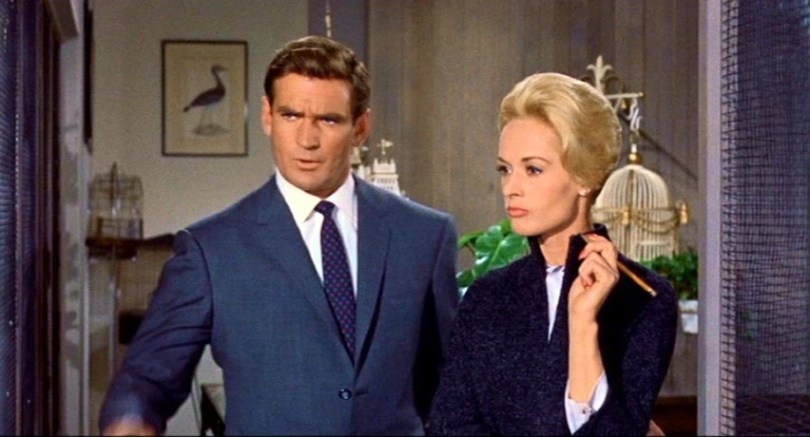
Coming back to the Birds, yes, the movie was all about Tippi Hedren and those ‘birds’ – zillion of them gone crazy. However, playing a lawyer, Rod Taylor as ‘Mitch Brenner’ enacted well, protecting the ladies despite the birds taking the limelight.

The fascinating part of the movie was that it had no real motive at the end of it all. This was a movie that showcased what birds, lots of them can achieve if they go bonkers. I will write another post on ‘Birds’ and what I felt about it; for now, it is time to bid goodbye to the life of this talented Australian actor who could have achieved much more and was last seen playing the role of Winston Churchill in Inglorious Bastards. 

FANTASTIC VOYAGE – AND HOW ISSAC ASIMOV ENDED UP A WINNER

Many people think alike – so much so that there was a need to patent one’s ideas and copyright them.

In the entertainment industry, scripts were safely guarded for this purpose; on occasions, it did go out of hand once in a while,

It did in the case of Fantastic Voyage and I Dream of Jeannie.

People who have watched the show ‘I Dream of Jeannie’ in the mid-’60s and at a later stage would recall a particular episode, ‘The Moving Finger’  (watch the episode) – in which a movie production approaches Major Nelson, an astronaut to consult on a science-fiction movie.

The plot goes this way: *“An American astronaut, shrunken to the size of a pinhead, is injected into the bloodstream of a Soviet astronaut, works his way to the brain and retrieves information vital to the defense of the country.”

While the concept is indeed mind-boggling and exciting, none of it happened in that episode. It remained just a scene and nothing more. A few months later, in 1966, a movie that had its plot based on the above idea was released. However, Fantastic Voyage as an idea was made on the screen based on a story by Otto Klement and Jerome Bixby much before the episode of ‘I Dream of Jeannie’ aired.

HOW IT ALL BEGAN

The story’s screenplay included few details that would add drama, and what better than ‘the Cold War’ angle. This time the battle between the United States and the Soviet Union was not on ‘outer space’ but ‘inner space.’

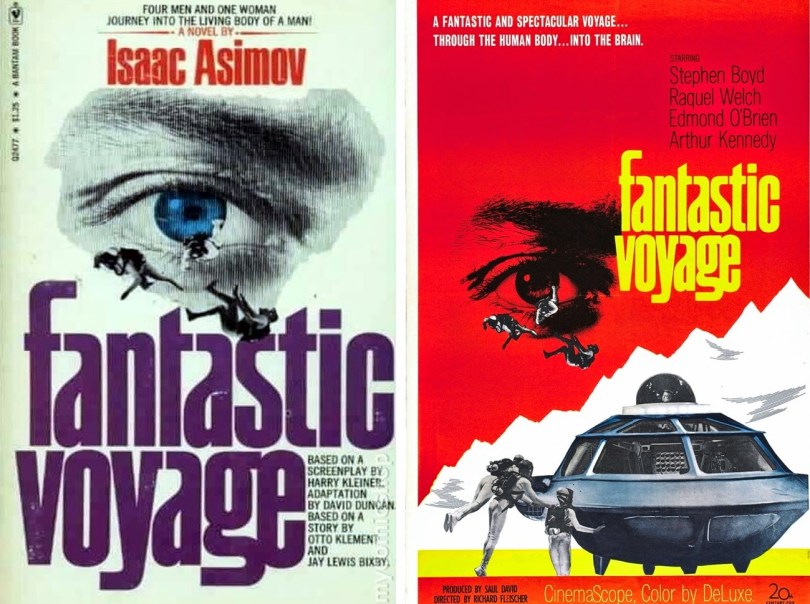
Movie on this idea was on, and Bantam books had bought the rights to novelise the screenplay at that time. Enter Issac Asimov, the science fiction expert, who was approached to write the novel based on the script. There was hesitation on his part before being offered complete freedom in writing the story.

As it turned out, he quickly drafted the idea and completed the novel by the end of July 1965.

The hardcover edition was published in March 1966 with Otto Klement entitled to royalties as it was his script in the first place irrespective of the fact it was Asimov who pushed for the ‘hardcover’ edition. It was a happy conclusion at the end of it all when Klement managed to serialise the story for ‘The Saturday Evening Post’ and the payment of which was agreed to split into two between Asimov and Klement.

Bantam Books, which had the rights only for the paperback edition, released the book coinciding with the film’s release.

IT WAS ASIMOV’S GAIN

There were delays in completing the movie on time due to various production issues, and all this only ensured Issac Asimov to be the biggest gainer at the end of it all. The public was aware of the novel authored by Asimov before the movie was released. This contributed to believing that Asimov is the ‘genius’ behind the idea of the film.

It doesn’t matter who was behind what; the movie was well appreciated and incorporated the special effects inside the human body – a place where no human has ever been to. Fantastic Voyage is indeed ‘fantastic,’ and apart from the outdated on-screen special effects, concept-wise, it is an evergreen classic!


MY FIRST WINTER RUN – SILVESTERLAUF ZÜRICH

The 38th edition of the annual Silvesterlauf (Silvester run) came to an end last Sunday in Zürich. Among the 21,643 runners who registered for the event, I, too, was one of them.

This was my first run in conditions that were below 5 degrees. Unlike my other runs in the past few years, this was different weather-wise while running terms; I did not feel a strain since preparing well in advance helped me get used to running in such conditions.

Well, in all fairness, I have run at the races without preparation (including a half-marathon). As a result, I have also suffered from those body aches, niggles, and other small bodily discomforts. I didn’t want any of this, and I wanted this run to be like a typical run, a feeling of routine from my daily life. This was my goal, and I am happy I was able to achieve this small milestone.

THE CHALLENGE

For a long time, I have spent winters that hovered around 15-20 degrees. Yes, it is a paradise by its looks; hence, my breathing and tolerance to cold weather and sub-zero climates had to be adaptive.

One of the best methods to adapt to colder conditions is to face them, train in them, and giving the body an incremental challenge to get used to the surroundings. Last year, I could not manage to take part in the ‘Silvesterlauf’, and this year, I was determined to take part if I were to be in Zürich.

TRAINING  

I kept it simple – just made it a point to spend time outside with relatively less warm clothes by jogging and running. This time the weather leading up to the race helped me train better. There were many days late in the evening where temperatures were below ten °C consistently, and on few days, it hovered around five °C and less.

I spent anywhere between 15 minutes to 40 minutes training depending on the time, and I managed to complete the full-distance at least twice a week, if not more. This gave me the confidence early on – that I could finish the distance without gasping for breath and in relatively quick time!

I prefer variety over mundane training, and this included the route I chose each day. I measured a lot of distances within my town and the neighbouring two towns and came up with many options. For a given length, I had close to 5-6 route variations to choose from, which helped me a lot!

Maybe, it is me and something to do with personal preference and my curiosity to explore more ‘routes’ within the distance I wanted to achieve.

THE RACE DAY

The race day was a Sunday, and I treated it just like ‘any given Sunday.’ As I mentioned in my earlier posts, short-distance running is an extension of my lifestyle and not something I have to spend a lot of time. My race was scheduled at 18:35, and the weather conditions were not too bad, or that was how I felt, minutes before the start.

The beauty of Zürich Silvesterlauf is – that you get to run around the busiest parts of the city, which is impossible on any other day or time. And once on the run, it was auto-pilot in action, and I ran at my own pace without bothering what was happening around me while soaking up the carnival atmosphere and managed to complete the race well within my target.

NOW  WHAT

A day’s rest and the usual routine starts. Though there are no runs scheduled till the Springtime, I will use this time to get used to training in sub-zero temperatures and explore more on adapting to colder conditions. 

LEARN TO LIMIT AND REAP THE BENEFITS

Have you ever tried searching for the term ‘Limit’ on Google? I see there are innumerable quotes which many renowned personalities have stated on one’s limits. What do these quotes convey? They all pretty much sing to a single tune – ‘never allow anyone to limit yourself.’ Taking the advice, I have decided to limit myself (instead of others) on essential things to my existence.

There are limits in life for a reason. Staying within limits has done wonders in life, and at the same time, one must remember, it is not easy to define a specific limit.

It is not something one can copy looking at what others have achieved. A limit should be defined in life depending on one’s lifestyle, surroundings, interests, profession, motivation, commitments, getting out of comfort zone, the need to create new benchmarks, and so on…

I do not believe in the adage – ‘there are no limits.’ From my experience so far, as long as human life is limited (as death is unavoidable), how can one define ‘limitless.’ Instead, I would say, we can reach a new limit, create a new benchmark, set a new time – all these are possible and within reach. Limitless cannot be measured and hence wonder, how can I achieve that state!

Let me give you an example from my own life. It took me a long time to admit to me not enjoying running long distances (10k and more). Was I limiting myself? No, I have been running long distances for quite some time, and it doesn’t entirely give me the ‘kick’ I need at the end of it.

Since this realisation, I have started to enjoy my short bursts of running and now confident of completing 5k at ease. Currently, happy with this arrangement, I feel my body and mind are in tune with this new set up. And, all that’s needed is 30 minutes of my time, three to four days a week. That’s 2 hours out of 168 hours, and I can gradually see the overall benefits devoting this little fraction of time in a week.

Now that I have worked out (till the time I realise something new), a schedule not following this routine is my definition to limit myself. Having many interests in life, committing myself to remain fit is just one of them – an important one indeed.

When I know I am good at other things (I can improve and learn more) or if I need to give attention to other aspects of life, why do something devoid of enjoyment and waste my time on just one part?

Fitness is essential, and there is nothing extraordinary here – I have just repacked my fitness schedule (lifestyle) to suit my personality. Let that be running or on a clear day cycling or just walking or just doing some floor exercises, swimming, playing a sport with friends, partner or kids, etc. An idle mind is a devil’s workshop; what about a passive body?

When you encounter a situation where you do not find any time, all you have to do is get out of everyone’s attention and honestly ask yourself if you want to do this. If the answer is yes, start small, learn to enjoy, and climb up.

Ensure you are not giving up other necessary commitments; instead, you are welcoming a value addition in your life. That’s how I look at it. If it is no, well……….. I leave that with you!

THERE IS NO PERFECT……………………………………………….

I know everyone has been in a dilemma of whether to do or not to do; to have or have not and how!  This feeling is universal, and the path is frequently travelled, most times crowded, yet it seems like we are all by ourselves. However, what we choose to do with the feeling is something worth talking about.

How many times a day, a minute, we would have procrastinated ‘a sure thing’ for later or even convinced ourselves to do it at a perfect time?

Let me tell you; there is no perfect time!

Many tasks need an appropriate time; anything before and after is of no use. We all get that sort of commitment, and we ably do it. However, there are many jobs which are independent of ‘time’ is what irks us the most, tests the individuals and a group in general. What are we going to do with the time if we have procrastinated on a specific task? Is there something better to do, or is it a feeling that comes in between performing that particular task – which quickly gets postponed? Or are we just too lazy and oblivious about it?

I have learned this, and yes, I, too, have procrastinated and will do in the future. Isn’t it natural? The question is – when do I procrastinate?

These days, I have started to question the very process of procrastination. I am in the middle of creating a habit of asking why I feel like delaying a particular task with the hope the process will evolve and gradually becomes instinctive.

LOOKING BACK

When I look back, I see a pattern emerge as to what factors motivated me to procrastinate things in my life. I would categorise items or tasks into priority. If I felt it was not significant, they would be done later, or I would do specific tasks only when required. Whereas many functions in our daily lives are intuitive, and you know it needs to be done.

Why so? Because you know it, and you will find a way to get things done…Period!

It is natural; it’s instinctive, it’s common sense, it is one’s reaction to individual action and is to no small extent a degree of freedom where you do without an iota of thought.

Such behaviour emerges with practice and being more aware of what ticks you! Just like a feeling of being an artist who has mastered an art. Everyone loves to be in this kind of a zone, I know I do… but – there are more roadblocks one needs to overcome to get to this zone. This is one’s behaviour – and whether it is good or bad depends on how you define ‘good or bad’ and how others perceive it.

50:50 CONUNDRUM

I remember a famous quote printed on a T-shirt I used to wear during my college days – “A person who thinks he can and a person who thinks he cannot are both right.” A beautiful quote wakes your brain cells and makes you wonder which side of the pasture you want to graze.

I often go through scenarios in life that I term as 50:50 conundrums. The more I encounter such situations – the more I am experimenting or being adventurous. Or am I taking too much time to learn or adapt?

I believe this is more of a personality issue. This dilemma, which I talked about earlier, tests or perhaps decides many things in one’s life.

More often, I encounter these thoughts – “How would it be? What will happen? How will they view it? Is it worth doing it? Will, someone judges me because of my actions?…. plenty of questions, and these questions bog me down at times and have the potential to mask the clarity of what is required, what needs to be done, and how it needs to do.” Sometimes it makes me wonder – why an inevitable result is not coming my way, do I need to find other ways?

Personally, this ‘feeling of uncertainty and making sense of it’ is what makes me learn. I am a person who likes to reach the same destination in different possible ways – well, it’s just me, and I don’t think about it. I do think about it!

Without this problem, I would have learned less. This uncertainty does not drive me crazy. Instead, it buoys me to ‘choose’ and go through a series of ‘action-reaction’ thoughts within myself and try them out in reality.

It is a feeling where any feedback is like progress, which is how I wish to take it. Back in my days as a chemical researcher, I learned an important lesson. “Even a negative outcome is a result, and to get to the objective of an experiment, one cannot fudge the results or tamper with the observations.”

It is entirely against nature – a lesson for life indeed.

A SECOND LAYER

Beneath the polished mindset lies the second-layer where the 50:50 conundrum is most active. This is where one’s character is shaped and one crucial step away from revealing to the world. This aspect determines how to proceed further and in what direction, and most importantly, when or give up. This zone is what I call ‘a critical one’ – where one is exposed to a lot of things or new scenarios, and one doesn’t know how to react to it and not confident of taking some actions.

If things go our way due to making a choice, we do not think much – a sense of relief surrounds us, and we began to wonder – what the fuss was this all about.

What if things do not go as per expectations? This is what happens to most of us during experimentation, right? When decisions have to be made, one needs to bounce back or come back with another set of ideas or leave it at that.

People get segregated and get defined by choices based on their awareness. It is not the result; it is the numerous trails that test whether you have it in you to drag yourself forward.

When there are chances to get lost for a while, or at least I do… go into a mood of introspection – visualise the sequence of events and come back at it.

This is a personality issue, and I believe in tackling this – there is no perfect way or to get back; there is no ideal time…

I do understand, when in doubt… make a choice towards what you want and accumulate as many responses (it is incredible how humans instinctively select or reject depending on their interests) as possible. Very soon, you will be out of this 50:50 conundrum, and your actions become instinctive. What’s important is – it is ok to be awkward as long as it is part of the learning process.

THE CORE

One needs fuel to execute things in a manner we do. I call ‘the intellectual fuel’ – which is present within and replenished as a result of our behaviour and its outcomes in everyday life. It is one’s core and the primary source of ‘how we do things in a certain way and be unique.’

This core of mine is a very personal thing. It takes ages to realise why we choose one over the other. This understanding of one’s core needs pattern, and that one has to keep doing things repeatedly.

It remains in the comfort zone and seldom takes risks. It is a haven, and it convinces you to believe your view is the way to go. When surroundings favour such thoughts, the result is a blast’, and the little one can stop! Unless you press the self-destruct button by yourself.

What would you do if you are not being judged? Think about it – dwell on it from time to time because this is what stands out with time.

The most challenging task is to be in touch with this core. And the annoying part is; it shows only a part of it and not entirely at once. If you are aware of this part – trust me, you will have never have to worry about the puzzles.

What you think or believe deep inside is what you do?

In most scenarios, one never encounters an ideal match that resonates your core. Either you condition the core to suit the surroundings or be continually looking out for ‘the one.’ In both cases, you invest time, energy to make it comfortable. The 50:50 conundrums continue…..

I have not reached there yet. But all I have understood is that – our life will be determined by the choices we make when we are in doubt. And how we react when things do not go our way is when we get to know more about ourselves.

So here is food for thought – how motivated are you to reach a state where you do just the way you like without any inhibitions? This explains why some people choose to become recluses; stay away from civilizations, and be available to people at their discretion. No, I have not met such a person until now in my life… because I believe that’s the perfect state one can achieve.

As long as you live.. you learn.. and as long as you know… you are not perfect!

TREADING ON THE MILL

I believe a personal level of acceptance (Read Previous Post – Why I don’t love Running) has helped me understand and look at the concept of ‘running’ in a completely different way. It is nothing elaborate, just that I feel a lot freer whenever I run, jog, or sometimes ‘waun’ (walk+run).

All along, I wondered – why conform to the norms of training? Though I never took any active measures to ponder what or how I wanted to run. Now, I want to know more.

I realise the importance of training to suit my body type and to get better with time. I had some ideas, and reading perspectives and runners’ life stories helped me get few ideas on various elements associated with running.

However, it is important to start testing those perspectives one by one. I ran, ran from time to time before realising I was not enjoying it. Instead of holding on to it tightly, I thought about rediscovering the touch by starting from scratch.

Most would know instinctively what’s möglich and what isn’t? It is a matter of effort, and it might involve some time (proportional to effort) to trust those instincts and enjoy the process of training. Be it anything, work out a pattern. Here’s what I did:

When I realised I could use the treadmill to train myself (I was not too fond of it before), I thought, why I never fancied myself training on a treadmill early. It’s simple – I never gave time to treadmill training nuances and instead preferred running outside, where I could control speeds and choose roads at will.

Now, I still love running outside but what’s changed is that – I do not mind using treadmills. Acclimatising to ever-changing seasonal weather also helped me to decide to give the treadmill a go.

Ok, coming back to the pattern. This technique is a work in progress. More work has been done, so I can comment on the progress I have had so far. Have a target time and commit to engaging yourself on the treadmill – it helped me define a direction because it was a personal project.

I would suggest ‘music’ helps – but it masks the feelings you undergo during this training process. I prefer to hear my feelings out during training and focus on achieving a zone where I just run, oblivious to what’s happening around me. Again, choose the method that aids you to train better!

I get a lot of ideas if I listen to my thoughts on how to make this process of training better.

Start by selecting a raw walking speed, a factor that indicates the km/h or miles/h. When you start to feel comfortable walking, shake up the order – plan to move outside your comfort zone gradually.

I devised a test on myself to simulate the outdoor running conditions at will. No, it isn’t the 3D views of my surroundings! I continuously increase the speed by 0.1 km/h every 30 seconds. I start my training with – say, 7 km/h (again, this is my comfort zone). A gentle walk for about a minute or two, and then I start jogging. The moment I begin to jog, I increase the speed by a factor of 0.1 and continue this trend every 30 seconds.

Now, my concentration is focussed on those 30s and multiply into as many intervals as you can. My target is not to run more than 5km at any point in time. Start at some speed, run, walk, jog for some time and track your progress.

We all love change for the better. The more challenging part is the path. I believe humans are creatures of evolution and not a revolution in the long run. So keeping this in mind, my training involves a gradual increase in speed.

It does not harm you and will only improve your fitness levels and, more importantly, the confidence levels. Who doesn’t want to feel better? This method of training is one such way of creating ‘those feel-good factors’ within you.

And why am I doing this? I believe in testing my abilities and move towards excellence, if not perfection, during my lifetime. So I pick up hobbies (trial and error), habits that trigger my brain, fuel my creativity, and test my limits.

I love experimenting with something I fancy or inclining to shake up the norms from time to time.

I don’t love Running!

I took to the treadmill very late in my life as a basis of training. There is something about these treadmills that create a feeling of ‘suffocation’ while I am on it. And this feeling stayed on with me until very recently.

Eureka! It took some beating to accept that I do not prefer treadmills, and more importantly, I am not a massive lover of running. I like running – but I am not a big fan of it. I run when it is needed, I sprint when I least expect it, and I speed walk as a matter of habit.

The bottom line is – I don’t love running. Oh, this sounds very different from saying – ‘I hate running,’ which I don’t. Isn’t it?

Now that ‘particular ego’ has been conquered let me move on. It has been so far smooth sailing in the past few weeks when it comes to running. Mind, body, and my inner soul connects well whenever I wish to run. The only question I had to answer was – How much is too much?

I began expecting too much from college and ended up running 21 km and several 10 km runs. I had injuries to my ankle (not while running), which made me feel not to run for close to two years until the time I started to run again in Doha, Qatar.

After completing a few 10 km runs in the past year and a half (five), I realised one important thing – ‘I do not enjoy running for more than 30 minutes’.

Yes, it’s me! It took me time to understand this level of understanding after running more than an hour all these years. What a revelation, phew!

Now, I revel in my 5 km runs and not sure how long this will last. However, I must admit I never relished so much during these 20 to 30 minutes of the run than I ever had in my ten years of running life. I believe that’s where I learned a key message – “It doesn’t matter where and how you do it as long as you like the process of doing it in the overall scheme of things.” And another important message – ‘Run your race.’

This belief of ‘enjoyment in the process of running’ is my secret of sorts for constant motivation to turn up any given day and run. And while I am at it, one never knows if this expands my boundaries!

And who knows few years down the line, I will be enjoying running the entire duration of 60 minutes or more. For now, I let myself savour this new ‘discovery’ within me.

Like I said – ‘I don’t love running,’ but I am more comfortable with the idea and benefits of it whenever I run these days. And in fact, this discovery has only made me run more regularly and consistently than I ever did in my entire life. To top it, it doesn’t matter where and what I run on!

The Secret Life of Walter Mitty (1947)

Signs of modern chivalry – the protagonist lives in a world, imagines himself to be the saviour and all the adjectives that can be used to describe the man known as a ‘hero.’

Walter Mitty comes across as a simple guy laced with innocence and a penchant to escape from reality, putting himself in extraordinary situations, lost in a world woolgathering with the focus entirely on his escapades involving a woman caught in a web of helplessness.

In the event of hopelessness and adversity, Walter is their go-to man, displaying guts of a bravado, prowess in entertainment, or just about any field – he is a master of it all.

The story was presented last December to the audience repackaged, keeping in mind today’s generation. In the past week, I have the opportunity to retro-analyze this theme of Walter Mitty.

Having got impressed with Ben Stiller’s direction, I watched the 1947 version of Walter Mitty’s Secret Life. Both these movies were based on the character created by ‘James Thurber’. It all started as a short story in 1939 for a New Yorker edition, became popular with the readers, which led to few radio adaptations and a major motion film in 1947.

Watching Ben Stiller and his secret life becoming public with each scene was an unbelievable experience. I was impressed by the screenplay and the breathtaking cinematography – which captured the essence and conveyed the story effectively. He is shown in America, Greenland, Iceland, and Afghanistan – all this a real visual treat. Though the story was adapted for the present audience, it does remarkable justice to this literary creation.

Comparing two movies of the same theme sixty years apart is not fair. I would have been disappointed if the story had no difference between the two versions. The former movie suited the audience sentiments and the preference of producers post-WW II – keeping in mind movies were business in the form of entertainment to the public.

Though the business element has not changed much, the same subject’s preferential treatments across different eras have evolved immensely.

From scene one in the original movie, the storyline and characters introduced are different from the short story.

The original story’s small plot was stretched to suit the major feature film standards barring few dream sequences.

The constant connection between the book and the movie is the adjective -Mittyesque, a condition given to unrealistic flights of fancy and escapist daydreams that the title character suffers from.

This condition could be from the fact that he works as an editor for a book publishing firm.

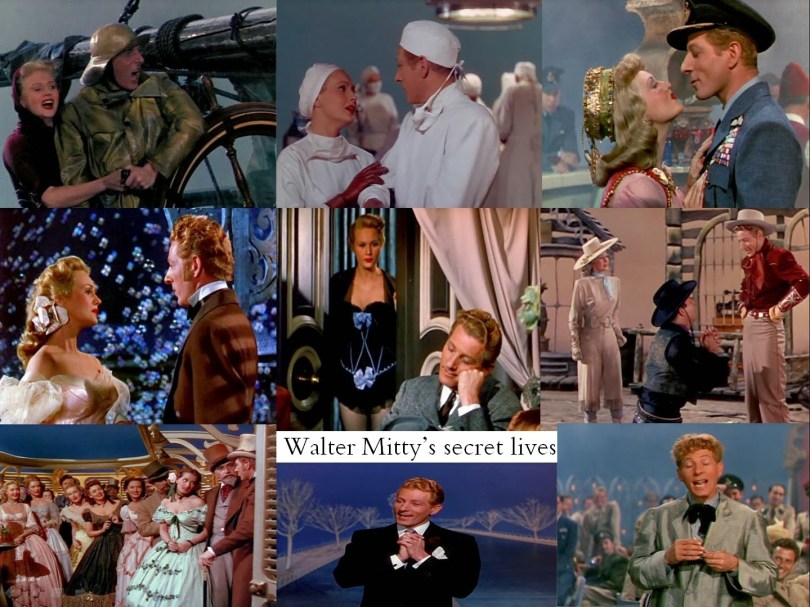
The narration is simple, interwoven with Walter’s frequent tendencies to dream about being a heroism symbol. Captain of the sinking ship, a multi-faceted surgeon, a WWII fighter pilot, a gambler, a French designer or a rodeo – he wins the heart of all, and in particular, a ‘dream girl’ who by coincidence turns out to be real and ends up being Mrs. Walter Mitty.

The movie is an entertainer. The tandem management with scriptwriters ensures a constant supply of comedy, idiosyncratic pantomimes, and songs most suited for an actor like Danny Kaye.

Walter is frequently bossed around by his mother, Mrs. Eunice Mitty. At work, it is his idea-stealing boss Bruce Pierce. Walter’s kid-wit fiancée Gertrude Griswald, Gertrude’s loud-mouthed mother, and Tubby Wadsworth, who woos Gertrude repeatedly and shamelessly form his world.

His daily life revolves around them. Not to forget his habit of straying away to a  dreamland, lost in the thoughts and actions, creating his heroic tales only to be climaxed by his transportation back to the real world.

His mundane life takes an exciting turn when he meets a mysterious woman, Rosalind van Hoorn who coincidentally fits and resembles the girl of his dreams perfectly. Rosalind works with her uncle to recover the lost Dutch treasure from WW II, and Mitty accidentally becomes an essential part of this rescue mission. His boring life becomes exciting and adventurous – the stuff of his dreams. With all the courage previously unknown to him, he helps Rosalind and ends up marrying his ‘dream girl.’

Author James Thurber based his character Walter Mitty on his friend, writer Robert Benchley. Thurber said that he got the idea for Mitty from Benchley’s character in a series of shorts that he made for Fox and MGM, respectively, in the 1920s and 1930s.

James Thurber, the author of the short story, acted as a consultant for a brief period to contribute significantly to the plot, which ended up in a bitter fight.

The script was modified as the producer Samuel Goldwyn demanded the movie to be written to showcase Danny Kaye’s talents.

Thurber, who was unhappy, went on record saying that he hated this film and that Danny Kaye’s interpretation of Mitty is nothing at all like he intended the character to be.

How would he have reacted to Ben Stiller’s portrayal of Walter Mitty? The 2013 movie was well made, and I was mighty impressed with the subject’s treatment.

However, the 1940s was a different era, and personally, some of the dream sequences involving Danny Kaye were a bit of a drag, and the editors could have kept it short, keeping in mind this wasn’t a musical in the first place.

Nevertheless, Danny Kaye performs remarkably throughout the movie displaying his repertoire as an entertainer, while Virginia Mayo’s presence as Rosalind and as ‘dream girl’ will not go unnoticed.

If you can spare 110 minutes of your time and have a hint of inclination towards yesteryears’ musical-comedies, then I suggest this movie be entertaining, if not a masterpiece!

The Petrified Forest (1936)

Leslie Howard, the soothing actor, and the enigmatic Bette Davies were the top-billed actors in this Robert E Sherman’s adapted play, and my question was – Where was Bogie?

Humphrey Bogart’s name appeared much later. There was talent, no doubt, and before this role, there were ten other productions he was part of, though none of those roles stood out. He was present – playing second fiddle or a character role, and I bet the top billing status was a long way ahead.

I belong to a generation who have seen many Humphrey Bogart movies in which he has been the main draw. The descending order of his filmography I have gone about watching made me realise how far I was getting away from his stardom. He was at the peak when I watched him first, and now after a lot of movies, I have seen merely a reflection of his future status or under the shadows of other stars, namely James Cagney.

And when I watched ‘The Petrified Forest,’ I somewhat knew this was where it all began for him. Since then, he has grown as an actor, slowly moving away from being the gangster to being a hero and a star of whom there is a rich legacy.

The movie itself is a journey – a conversation between individuals about their pasts, experiences, dreams, and shortcomings.

Set in the backdrop of a region where the scientific process of ‘permineralisation’ is evident. Trees are mostly found in fossils – petrified wood highlighting the years of reaction turning the wood into stone-like structures. This is ‘The Petrified Forest’ in Arizona, and the story begins and ends at the little service station called ‘Petrified Forest Bar-B-Q’ on the edge of nowhere.

A battered intellectual nomad, formerly a writer, is shown walking on the dusty roads of Arizona. From his looks, it seemed his best days were past him – Alan Squier, played by Leslie Howard, strolled through the roads on a mission to explore and find a purpose for his well-equipped brains.

He recognises the triumph of his thumb and its sideways motion with which he travelled lengths and breadths of America. He was hungry, impoverished and among his possessions were a rucksack with his passport, insurance papers, and a map.

By the time he had got himself to the embarrassing situation of having no money, the movie was half-way through. By this time, he had an admirer – no, a lover, Gabrielle Maple, played by Bette Davies, which left her blue-collared employee and former football (American) player Boze in distaste and jealous of Alan.

Gabrielle is the daughter of the diner owner Jason Maple and of Gramp Maple, who was not shy in telling the customers about being missed by ‘Billy the Kid’ once. Gabrielle was born to a French mother who currently lived in Bourges, France, after getting bored of her life in Arizona. Gabrielle assists her father and dreams of being an artist in France, someday!

Words have their magic and the power of attraction towards human beings. When these words always flow in any conversation, one can fall in love hopelessly.

Alan was eloquent in what he thought about life and the poetry collection of François Villon, a 15th-century French poet to which Gabrielle was hooked. He requests her to narrate some of the lines –

Such good I wish you! Yea, and heartily
I am fired with hope of true love’s meed to get;
Knowing love writes it in his book; for why,
This is the end for which we twain are met.

An awkward silence followed by more lines –

Seeing reason wills not that I cast love by
Nor here with reason shall I chide or fret
Nor cease to serve, but serve more constantly;
This is the end for which we twain are met.

While she showed him her artworks and the paintings, he talked about his experience, past life, strange marriage to a wealthy woman, writer’s block while living in Riviera, and the separation.

On the other hand, his words cast a spell on her to the extent that she was ready to run away with him taking all her cash; he declined and refused and decided to part ways.

He was on his way on a car with a wealthy couple only to be stopped mid-way by Duke Mantee and his men, who took the vehicle and spared their lives. A few moments later, Alan was back at the diner. Why?

The next half of the movie is about Humphrey Bogart – his guile, rugged looks, and the manner he was introduced made him the terrifying character the movie audience had seen at that time. He engages in a conversation with the rest of the crew at the service station.

After a series of thought-provoking conversations between Alan and Duke – the movie concludes with Alan Squier having found his purpose. He knew his life was of no worth, and his death could buy Gabrielle the tallest cathedrals, and golden vineyards, and dancing in the streets. He dies through a prior arrangement with Duke for killing him, thereby leaving her the insurance money. Alan was in search of a purpose – to live and to die for.

He knew he was in love with Gabrielle, someone worth living for and worth dying for.

Like I mentioned before, the movie took Humphrey Bogart to the next level, and this was possible because of Leslie Howard’s insistence of Bogart playing the part of Duke Mantee in place of Edward G Robinson.

It has a happy negotiation, which gave Bogie his first break in Hollywood. It was a mere coincidence that the real-life criminal ‘John Dillinger, on whose life is the character Duke Mantee is inspired from, resembled Bogart.

When Bogart’s daughter Lauren Bacall was born in 1952, he expressed his friendship and gratitude by naming her, Leslie Howard Bogart.

Howard refused to appear in ‘The Petrified Forest’ unless the studio (Warner Bros) signed Bogart to play Duke Mantee.

Sign they did and the rest is history!