I’m No Angel (1933)

There is a famous saying, “There is no business like show business.”

Mae West illustrates and depicts the role of a free-spirited ‘Tira’ in this 1933 movie, ‘I’m No Angel.’ Back then, she was already an established personality on screen, commanding immense respect among her peers in the industry.

Known for her witty one-liner and double entendres, Mae West stars in this movie in which she provides the story, screenplay, and dialogue.

To get out of a messy situation, Tira, in search of money, agrees to an offer to put her head into a lion’s mouth. The proposal was in New York and was a sell-out attraction. She attracted a lot of rich men.

A harbinger previously predicted her man of the future to be a rich guy with black hair. In search of this, she did socialise with men while explicitly going into the details specified by the fortune teller. Receiving presents through social gatherings from rich men was an everyday norm.

Jack Clayton, played by Cary Grant, tries to untie the infatuation of his friend with Tira. His friend was in a relationship, and to stop further embarrassment, Jack takes up convincing Tira to stop entertaining his friend. Along the way, Jack gets fascinated by Tira’s charm, and in turn, Tira feels she has found her man.

In her show business career, Tira made acquaintance with a lot of men; one such hopeless guy is Slick Wiley. He used to live on Tira’s money and never liked Tira getting close with rich men. When Jack and Tira decide to get married, Slick plays an evil trick on Jack’s claim that Tira was already married. The marriage is cancelled.

To get someone you love, one needs to fight certain circumstances. Tira acts as her attorney in court over a breach of promise suit. She questions the men from her past to prove her innocence. Misunderstanding is cleared, and finally, all hurdles are cleared.
Directed by Wesley Ruggles, this movie united Cary Grant and Mae West for the second and the last time together.

The Bishop’s Wife (1947)

If there is one particular theme I like in movies, it is the theme of Christmas. Films with such a theme instill a sense of belief and give a lot of people some hope. Hope to lead life.

If it wasn’t through life, it was through movies that people found hope, and even today, films are widely considered a medium where people find hope.

After a long gap, Loretta Young (The Bishop’s Wife) shares the screen space with Cary Grant (Dudley). To be precise, their last movie together was Born to be Bad, released in 1934.

David Niven plays a bishop’s role, whose role is mainly limited to the ambiguity between the new cathedral’s funds, family, and principles.

Why is this movie special? Is it because it has Cary Grant playing one of the most refreshing roles of his life?

Cary Grant, in his role as Dudley, plays the character of an angel. An angel who sometimes resembles our inner voice. In this chaotic world, one hardly listens to our inner voice; since it’s an opinion or a thought restricted to ourselves.

But when a feel-good thought comes from others’ suggestions, we usually pick it up and apply them on a higher percentage scale.

In short, people who are optimistic about their lives listen to such suggestions and go about leading their lives catalysed by such thoughts or ideas.

Even if it is for a short time, it is the jump start one needs to refresh and get out of crossroads. Professor, The Bishop’s wife, Mrs. Hamilton, and few others are the ones who had lost hopes in their respective lives, and an angel restored the same.

Dudley says, “Angel can be anyone on the street. Someone you don’t know but can bring in a lot of change in the way we would like to lead our lives.”

The other side of the coin, cynicism, exists as displayed by the Bishop, who refuses to believe in miracles, though being the almighty’s mortal messenger. He was adamant about building the cathedral; he even went to the extent of compromising his principles to raise funds.

His real prayers (raising funds) were finally answered, though not in a way he wanted. But who would question the method of an angel? The Bishop certainly did but didn’t succeed in overpowering the methods.

Dudley, the angel, spends most of his time with Julia, the Bishop’s wife, and their kid Debby, yet manages to answer the Bishop’s prayers. Strange method indeed.

The problem of funds was never looked at, and this movie epitomises true human nature emphasising the importance of winning over someone’s heart to get what we truly want.

Dudley won the heart of Mrs. Hamilton, who finally relented to the angel’s advice and decided to shed her ego. Donating her money, she helps the Bishop build his dream, the cathedral, which would provide shelter to the needy.

Dudley had to leave once the prayers were answered, but it was tough as he was attached to Bishop’s wife, cursed himself for being an angel; as he realised being an immortal, it was impossible to beat a mortal to win over a mortal’s heart.

Directed by Henry Koster, this 1947 movie was nominated in five different categories, including Best Picture, and it did manage to win one for the Best Sound Recording.

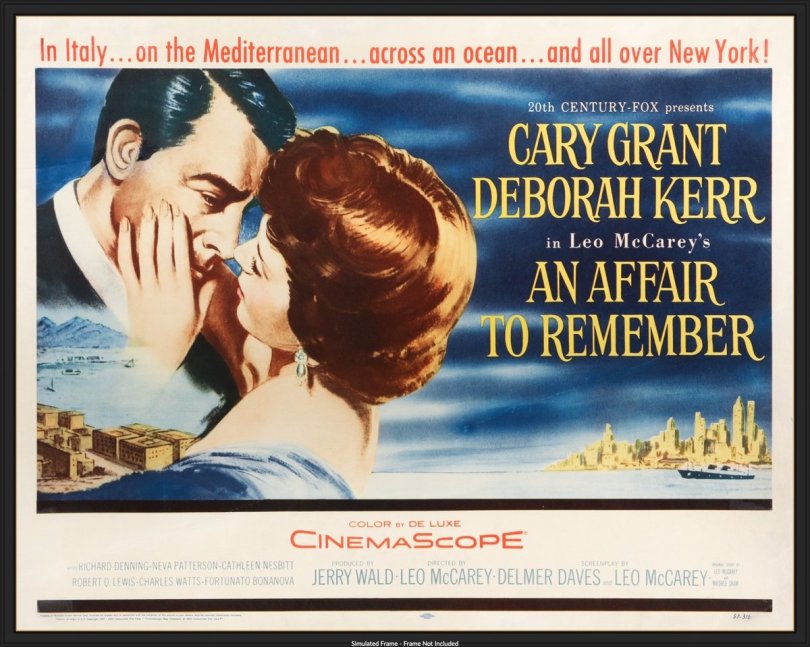
An Affair To Remember (1957)

What happens when a handsome playboy meets the gorgeous night club singer on a cruise. The first part of this Leo McCarey’s classic ‘An Affair to Remember’ showcases the above scenario. Cary Grant as Nickie Ferrante plays the playboy, and Deborah Kerr plays the dashing Terry Mckay.

Despite both being engaged, they couldn’t help themselves falling in love with each other on the ship and make a promise to meet after six months at The Empire State Building.

With engagements being on hold, both wait for six months to see each other on the building’s 102nd floor. A perfect story in progress until Debroah Kerr meets with an accident right on the day of the visit. Cary Grant striding to and fro on the 102nd floor, can only console himself. He waits the entire day and wonders why till the end of the movie.

Whether they would get married would remain unanswered, and accident becomes the reason that prevents the reunion of the couple.

The story was quite a drama back then, not the same as when it was made in Hindi in 1999. One can copy the theme, not the entire storyline and scene settings. ‘Mann’ starring Aamir Khan and Manisha Koirala, failed because it couldn’t connect to the so-called “modern-time” and not compelling content. Times change, hence individual perceptions on love change. Unfortunately, Mann wasn’t able to accommodate this change.

The highlights are the scenes shot in a garden mansion where Cary Grant takes Deborah Kerr to meet her grandmother. Their love blossomed at the very place. The last scene is a memorable one when Cary Grants holds Deborah Kerr.

This movie is a remake of the 1939 film ‘Love Affair’ starring Irene Dunne and Charles Boyer. Leo McCarey directed both.

An Affair to Remember was nominated for four Oscars in the Best Music, Best Costume, Best Song, and Best Cinematography categories.

His Girl Friday (1940)

Call it front-page news or inspired by a drama called “The Front Page,” His Girl Friday will be my pick for all-time favorite Cary Grant movies.

This was the second Cary Grant movie for me, and to be frank, I became a big fan of his after watching this movie.

Cary Grant (Walter Burns) plays the role of a Chicago-based newspaper editor. The story starts with him losing his main editor, who coincidentally happened to be his ex-wife, Hildy Johnson, played by Rosalind Russell.

She would visit him to say that she would be getting married in two days. She even introduces her to be husband, played by Ralph Bellamy (Bruce Baldwin), to Walter.

More than losing his wife, he wouldn’t want to lose his primary weapon in Hildy, who had quit the job for marrying Bruce.

Watch the movie to see the events, which keep rolling while Walter makes every effort to get Hildy back on the job. He ensures Bruce is placed outside the equation so that she doesn’t have to marry him.

Quite a selfish guy, to be honest, but it’s the dialogues and how he convinces Hildy to cover one final story about a convict.

Coming to the origins, the original story had a guy playing Hildy’s role. But director Howard Hawks was convinced the dialogues would suit better if a female plays the part.

The script was altered, and the rest is a masterpiece concerning situational comedy.

I have read a lot about this movie; this movie was one of the first, if not the first, films to have characters talk over other characters’ lines for a more realistic sound.

Before this, movie characters completed their lines before the next lines were started. I have just put a scene, which showcases this…

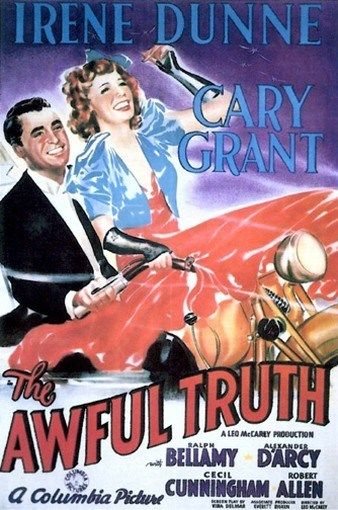
The Aweful Truth (1937)

This movie will be remembered as the first Cary Grant movie I ever picked up. Unlike his other classics, this movie doesn’t have a great story, but if one went back to the era of the 1930’s I am sure the theme of the film would have reflected the mood of many people, especially after their marriage.

 He stars as a husband who ends up having differences with his wife, played by Irene Dunne. The plot begins with the introductory scene itself and what happens later is a series of funny conversations and situations that kept me going till the end of the movie.

Cary Grant, who makes every attempt to ruin his wife’s future marriage prospects by continually interfering in her personal life while both wait for the divorce, played the role of a married bachelor to perfection.

Irene Dunne compliments the same to upset Cary’s prospects. Since I am a big fan of Cary Grant, I would say this movie was the first to showcase his comic persona, which became his trademark as he became a legend in the world of cinema.

This movie is about married couples, their differences, divorce, J factor, etc.

Released in 1937, The Awful Truth starring Cary Grant, Irene Dunne, Ralph Bellamy, to name a few, was voted as the best screwball comedies of the 1930s. This effort also won director Leo McCarey the best director Oscar.

For Fashion pundits, this movie is stylish concerning its outfits, especially the one worn by Irene Dunne in the first scene.