Notorious (1946)

Cary Grant and Ingrid Bergman’s on-screen romance was seen for the first time in Alfred Hitchcock’s thriller ‘Notorious.’

This film is highly rated for its screenplay. Some of the scenes involving Cary Grant and Ingrid Bergman were breathtaking, the famous being the on/off again kiss scene, the scene was shot in compilant with the Hayes code, that prevented a kiss scene from being no more than three seconds.

Alicia, the character of Ingrid Bergman, plays an undercover agent to the US Government to repay the moral debt. This was for the spying activities of her father. Her father was a German spy, and he ends his life committing suicide while in prison. The Government agent, T.R. Devlin, played by Cary Grant, carries out a mission to trap other spies, most notably Sebastian.

Most of the movie is shot in Brazil, where Sebastian (Claude Rains) and his other partners in crime are operating their mission. A top-secret project under a Wine Manufacturer’s name. The story unfolds with Ingrid Bergman playing the undercover and helping the US Government uncover Sebastian and Co’s malicious intentions. One can also see ‘Christ the Redeemer,’ one of the current seven wonders at Rio in the movie.

Alfred Hitchcock’s cameo comes during the party at Sebastian’s house. The director is having a drink.

Watch out for the final scenes where an intoxicated Bergman has some of the movie’s most refined lines. Cary Grant, unusually not with his humour wit, displays an angry look in the entire film.

Its such a rarity that one cannot see him smile still manages to pull off romantic scenes with such ease and guile.

This 1946 movie was nominated for two Oscars in the Best Supporting category for Claude Rains and Best Story (Original Screenplay).

Rope (1948)

The narration of a movie based on a ‘prop’ is interesting. This movie happens to be the first ‘Alfred Hitchcock’ movie in colour. The film was shot in a single set; this movie throws up many exciting scenarios and a series of long takes. This movie is loosely based on a real-life murder committed by University of Chicago students known as the Leopold & Loeb case.

The movie stars James Stewart as Rupert Cadell. Superior vs. Inferior’s debatable theory is the theme, and the whole film revolves around the hideous intentions being masked by this theory.

James Stewart has the final say and, in his way, explains while being ashamed of his theory ‘Superior vs. Inferior.’

Hitchcock doesn’t make a live cameo; instead, his profile on a neon signboard outside the window. Apart from James Stewart, John Dall as Brandon Call, Farley Granger as Philip Morgan are the movie’s main characters. Dick Hogan as David Kentley is the subject around which the film unfolds.

Sir Cedric Hardwicke makes an appearance for a while as David’s father. Joan Chandler completes the movie cast of a young actress missing the list.

(DISCLAIMER) The story is about a young student named David Kentley being strangled by a ‘ROPE’ by his friends Brandon Call and Philip Morgan. The reasons are not known and are not a matter of concern as far this movie goes. The only point was the intellectual superiority.

The body is hidden inside a chest where supposedly books were meant to be kept. Brandon hosts a party at his place to ensure everything is normal. He makes a mistake by inviting Rupert Cadell, who unveils the mystery when David’s absence in the party raised many concerns.

The movie was an adapted version of the same title in 1929 by Patrick Hamilton.

Released in 1948, the movie Rope was one of Hitchcock’s ‘Infamous five lost’ movies.

The Purpose Defeated

As I am preparing to sleep with music on, the whole point of this blog was unfruitful. I watched the movies because I wanted to watch them.

Never mind the delay in watching them, I can safely say I have made up for the loss. I am not 50 years old, and I am happy that cinema’s legacy as a cinephile, which my grandfather, my mother, and her sisters, brothers had, will continue through me.

I would say I have been in a mood to watch anything that people call ‘Old,’ ‘Dull,’ ‘Black ‘n’ White,’ ‘Old Actors,’ ‘Uncool,’ etc. These are, of course, gone on to become so-called ‘Classics.’

The best way to know actors, actresses, directors, writers are to experience their works, very similar to appreciate a musician by listening to his/her piece of work. My likes or dislikes will be a perspective. And to be honest, I can only influence a few, not create a revolutionary opinion.

This blog was meant to touch up the movies I have been watching, and it’s been a long time… I regret this; the purpose is defeated.

To the future, for the unregretful moments……… Till I call it ‘cut(s),’ instead of quits’

Irma La Douce (1963)

As a follow up to my earlier view on The Apartment, I must admit this movie is one of my all-time favorites—Irma La Douce (Irma the sweetest).

Jack Lemmon is remembered for his portrayal of Nestor Patou, an honest police officer who finds a street full of prostitutes in one of the popular areas in Paris one day on duty. He reports all the ladies to the police station in front of his senior officers. Aware of the activities, Nestor finds himself in false charges of bribe and hence thrown out of service by his old men who indulge in infixes.

He becomes close to Chez Moustache (Lou Jacobi), a local bar owner. While he is drunk, a bizarre sequence of events ends Pastor being the new pimp boyfriend for Irma as she dumps the previous guy. Pastor moves in with Irma.

He is in love with Irma and cannot digest the fact of being with other men; he comes up with a master plan of disguising himself as an old English guy (Lord X). Lord X offers Irma good money so that she can entertain only him.

To earn money, Pastor works for a meat processing industry during the night and early hours; hence most of the time, he ends up in bed tired. With time, this upsets Irma, and consequently, she finds solace by talking out her problems with Lord X.

Jealous ensures Irma’s ex-boyfriend kill Lord X. Pastor again becomes a victim.

Rest is all about how he manages to escape from prison and how he manages to convince Irma that he loves her more than anyone. One of the best comedies in Hollywood, Irma La Douce, was released in 1963 and was directed by Billy Wilder.

One of the fascinating things about Lord X is his strut and his comic timing. His ‘cheeribye’ is very catchy.

In a way, I wouldn’t like to describe much about this movie, as I would recommend everyone movie lovers to watch and enjoy.

Marilyn Monroe was touted to play the role of Irma; instead, Shirley Maclaine was chosen, as Monroe was dead by the time the production of this film started. Bollywood made a movie based on Irma La Douce, Manoranjan, starring Sanjeev Kumar, with Zeenat Aman and Shammi Kapoor playing the other lead roles.

I shall end the post with some of the memorable dialogues,
“Who wants to be a stray dog? You got to belong to someone, even if he kicks you once in a while.”

“Life is total war, my friend… nobody has a right to be a conscientious objector.”

“Shows you the kind of world we live in. Love is illegal – but not hate that you can do anywhere, anytime, to anybody. But if you want a little warmth, a little tenderness, a shoulder to cry on, a smile to cuddle up with, you have to hide in dark corners, like a criminal.”

“To be overly honest in a dishonest world is like plucking a chicken against the wind… you’ll only wind up with a mouth full of feathers.”


The Apartment (1960)

The last movie to win Oscar Best Picture in Black ‘n’ White was this movie. Of course, it was before Schindler’s list (1993). The Apartment made in 1960 was classic with reputed performers like Jack Lemmon (I can’t stop ravishing about him), Shirley Maclaine, aptly directed by Billy Wilder. This was a follow up from his previous smash hit comedy ‘Some Like it Hot.’

I was in tears because I was touched by Jack Lemmon’s simplicity, suppressing his feelings. The feelings when his boss, played by Fred McMurray, out of his marriage has an affair with Shirley Maclaine, and he can stand and do nothing about it.

The Apartment is in demand for few employees working at an insurance company in New York. The Apartment belongs to Mr. C.C Baxter, played by Jack Lemmon. To climb up the corporate ladder, he lends his Apartment to his fellow selected higher officials to spend time with their muses outside the house. The four managers keep their promise by paying positive appraisals to the personnel director, Mr. Sheldrake, played by Fred McMurray.

C.C Baxter is attracted to the elevator operator Miss Fran Kubelik played by Shirley Maclaine. It turns out, Mr. Sheldrake had sights on Miss Kubelik, and they were involved in a relationship, which ceases to have an identity.

Miss Kubelik cannot tolerate the mystery of their relationship in adverse circumstances, contemplating suicide and consuming sleeping pills at the Apartment.

C.C Baxter, to his shock, finds Miss Kubelik in a state of horror. Next few days, he consoles Miss Kubelik and even tries to bring a smile.

While his heroics of saving Mr. Sheldrake gave him a chance to become Asst. Director. He always dreamt of this position; now, he stalls himself to enjoy the newfound role.

Fast forward 37 years, Bollywood had its movie in Yes Boss, loosely inspired by the theme where Shahrukh Khan helped his boss Aditya Pancholi get Juhi Chawla in return for a better corporate future.

And in 2006, another Bollywood movie, ‘Life in a Metro’ finds a sub-plot similar to the screenplay of ‘The Apartment.’ Sharman Joshi does justice to his role identical to Jack Lemmon, while Kangana Ranaut and Kay Kay Menon play Shirley Maclaine and Fred McMurray to perfection.

However, according to director Billy Wilder, The Apartment was inspired when he had seen the movie ‘Brief encounter’ in 1945.

I like the ending scene.

It’s about the time when C.C Baxter and Miss Kubelik are about to start a game of cards.

C.C. Baxter: You hear what I said, Miss Kubelik? I absolutely adore you.

Fran Kubelik: Shut up and deal.

Its a Wonderful Life (1947)

I always wondered why life has a lot to give to us when least expected. Is it its way of testing one’s response? In any case, this movie gave insight into how situations pan out, which are very different from one’s dream.

This is a story of George Bailey (James Stewart) and his altruism. He always dreamt of traveling places. However, due to his father’s sudden death, his plans had to take a back step. Instead, he takes over his father’s loan and building company. Mr. Potter’s (Lionel Barrymore) malicious intentions are always cut short by Bailey’s love and affection for his town and the people.

To give a glimpse of what this movie is about:

Few days before Christmas, disaster strikes, and some part of the company’s money is lost when Bailey’s uncle was depositing in the bank. Mr. Potter, who was well aware of the possible consequences, would hide the money. Fearing about his company shut down for money loss, a frustrated and clueless Bailey contemplates suicide.

His years of goodwill ensured an angel named Clarence, who wants to earn his wings, comes to earth. He shows Bailey how his town as if he hadn’t been born. The city would have been in chaos under Potter’s reign. His family members are either dead or led a life of misery.

This probably made Bailey understand the positive impact he had on people’s lives and re-consider his suicide, and realize what a wonderful life he has had. He did want his life back, and more than ever, he wanted to live again.

This was the first movie I had seen of James Stewart and that of Frank Capra, and it happened to be the starring debut for Donna Reed, who plays Mary Bailey.

The movie has many claims and is widely rated as one of the top films never to have won Best Picture Oscar only behind Shawshank Redemption. On the technical front, this film did innovate a unique method of creating snowfall.

Personally, this movie was one of the first Black ‘N’ White films I had seen as a college student. It did have a positive impact on my life then. Four years hence, I still feel the same vibes when I think about this movie.

In the last scene, when Bailey’s daughter is very apt looking at the situation he had to deal with the angel.

At his home when the party is on, sound from Christmas bells…

Zuzu Bailey: Look, Daddy. The teacher says, every time a bell rings, an angel gets his wings.
George Bailey: That’s right, that’s right. Attaboy, Clarence.

Charade (1963)

A viewer’s delight. This movie had two of the great movie stars seen on screen, which marked the first time they starred together. This is Stanley Donen’s romantic-suspense drama ‘Charade.’ A movie that could have been a Hitchcock thriller or a James Bond movie.

The first time when I heard about this movie was in a local quiz competition. Our team didn’t get the answer to the introduction scene of this movie. The movie title always fascinated me. That was just one of many reasons to watch this movie. Little did I know then, it would star Cary Grant and Audrey Hepburn?

Cary Grant was 59 and hence wasn’t convinced about romancing Audrey Hepburn, who was just 33 at that time. He did refuse the offers made to him because of the age difference.

Finally, Cary Grant did agree because of Peter Stone’s script’s specific change, the writer. It was decided that Audrey Hepburn would be pursuing him, and promptly the romantically aggressive lines were shifted to Audrey Hepburn’s character.

This film also reiterated the fact of Cary Grant playing action roles with ease. He refused James Bond owing to age. Apart from these legendary actors, Walter Matthau plays a pivotal character.

Audrey Hepburn plays the character of Regina Lampert, who would lose her husband through murder. Many of his friends would come to take the money, which was stolen in gold from US Government during WW II. She is ignorant about his past, and the plot continues when three of her husband’s ex-partners in crime, the US Government, all chase her in search of money. The screen name of Cary Grant changes every 20-minutes in the movie, who has a protective and selfish motive in the film. The film is shot mainly in Paris and Switzerland.

This movie, made in 1963, was a box office hit, and this movie happened to be the only time Cary Grant and Audrey Hepburn appeared together on screen. Cary Grant had refused ‘Roman Holiday’ earlier, which ended up being listed in Time’s 100 Greatest Movies.

Apart from Audrey Hepburn’s lines, I love the last scene where Cary Grant chases Audrey Hepburn. Why does he pursue? Watch the movie and find it out yourself.

His Girl Friday (1940)

Call it front-page news or inspired by a drama called “The Front Page,” His Girl Friday will be my pick for all-time favorite Cary Grant movies.

This was the second Cary Grant movie for me, and to be frank, I became a big fan of his after watching this movie.

Cary Grant (Walter Burns) plays the role of a Chicago-based newspaper editor. The story starts with him losing his main editor, who coincidentally happened to be his ex-wife, Hildy Johnson, played by Rosalind Russell.

She would visit him to say that she would be getting married in two days. She even introduces her to be husband, played by Ralph Bellamy (Bruce Baldwin), to Walter.

More than losing his wife, he wouldn’t want to lose his primary weapon in Hildy, who had quit the job for marrying Bruce.

Watch the movie to see the events, which keep rolling while Walter makes every effort to get Hildy back on the job. He ensures Bruce is placed outside the equation so that she doesn’t have to marry him.

Quite a selfish guy, to be honest, but it’s the dialogues and how he convinces Hildy to cover one final story about a convict.

Coming to the origins, the original story had a guy playing Hildy’s role. But director Howard Hawks was convinced the dialogues would suit better if a female plays the part.

The script was altered, and the rest is a masterpiece concerning situational comedy.

I have read a lot about this movie; this movie was one of the first, if not the first, films to have characters talk over other characters’ lines for a more realistic sound.

Before this, movie characters completed their lines before the next lines were started. I have just put a scene, which showcases this…

Sabrina (1954)

The aura doesn’t diminish, and Sabrina Fairchild’s role will be an all-time favourite character of mine. Surprisingly, this was the first Humphrey Bogart movie I saw. Well, the well-known films of his were all before this movie.

Audrey Hepburn overnight became one of my favourite actresses is because of this movie. The role of Sabrina has such innocence that one would fall in love with her immediately.

The story goes this way, as narrated by Sabrina.

Once upon a time, on the north shore of Long Island, some 30 miles from New York, there lived a small girl on a large estate. The estate was very large indeed and had many servants. There were gardeners to take care of the gardens and a tree surgeon on a retainer. There was a boatman to take care of the boats: to put them in the water in the spring and scrape their bottoms in the winter. There were specialists to take care of the grounds: the outdoor tennis court and the indoor tennis court, the outdoor swimming pool, and the indoor swimming pool. And there was a man of no particular title who took care of a small pool in the garden for a goldfish named George. On the estate, there was a chauffeur named Fairchild, who had been imported from England, years ago, together with a new Rolls Royce.

Fairchild was a fine chauffeur of considerable polish, like the eight cars in his care, and he had a daughter by the name of Sabrina. It was the eve of the annual six-meter yacht races, and as had been a tradition on Long Island for the past 30 years, the Larrabees were giving a party. It never rained on the night of the Larrabee party; the Larrabees wouldn’t have stood for it. There were four Larrabees in all: father, mother, and two sons.

Maude and Oliver Larrabee were married in nineteen hundred and six and among their many wedding presents was a townhouse in New York and this estate for weekends. The townhouse has since been converted into Saks Fifth Avenue. The elder son, Linus Larrabee, graduated from Yale, where his classmates voted him the man Most Likely to leave his Alma Mater Fifty Million Dollars. His brother, David, went through several of the best eastern colleges for short periods and several marriages for an even shorter time. He is now a successful six-goal polo player and is listed on Linus’s tax return as a six hundred dollar deduction. Life was pleasant among the Larrabees, for this was as close to heaven as one could get on Long Island.

Sabrina, since childhood, was fascinated with David (played by William Holden). He hardly notices her but still cannot keep an eye off him.

When things hardly seem to move, she is sent to Paris to a cooking school to take her mom’s place as a cook in the estate. In Paris, she undergoes many changes intellectually, and when she is back to Long Island, she returns as a gorgeous lady. That’s the magic of Paris!

One scene that attracts is when Sabrina, while she waits for a cab, is noticed by David and offers her to give a lift without realizing she was Sabrina, the chauffeur’s daughter.

Oh, Hello… How are you??? asks Sabrina

Hello…. I am fine… How are you? I mean, who are you? David replies….

All this time, Sabrina was warned that she was trying to reach the moon. She believed the moon was trying to get her after her transformation.

The rich and poor status quo comes in between, and this is when Linus (Humphrey Bogart), brother of David, steps in to resolve it.

Rest is something; I would love the movie to narrate because some of the best dialogues and scenes are reserved for Sabrina and Linus.

Linus Larrabee: [while slow dancing with Sabrina] How do you say my sister has a yellow pencil in French?
Sabrina Fairchild: Ma soeur a un crayon jaune.
Linus Larrabee: How do you say my brother has a lovely girl?
Sabrina Fairchild: Mon frere a une gentille petite amie.
Linus Larrabee: And how do you say I wish I were my brother?

Sabrina was the first movie I watched of Audrey Hepburn. Cary Grant refused the role, and Bogie was a late replacement for him.

This movie was later made in 1995 with the same name, starring Harrison Ford playing Linus, Julia Ormond playing Sabrina, and Greg Kinnear playing David.

This is not all; the 1994 Bollywood movie “Yeh Dillagi” was inspired by the 1954 film. Scene to scene, one can see the resemblance. Kajol, playing the title role of Sabrina, while Saif Ali Khan plays David and Akshay Kumar playing Linus.

Directed by Billy Wilder, this 1954 movie earned Audrey Hepburn an Oscar nomination for best actress. Her haircut became a sensation. This movie managed to bag the Best Costume design (B/W) Oscar nevertheless.

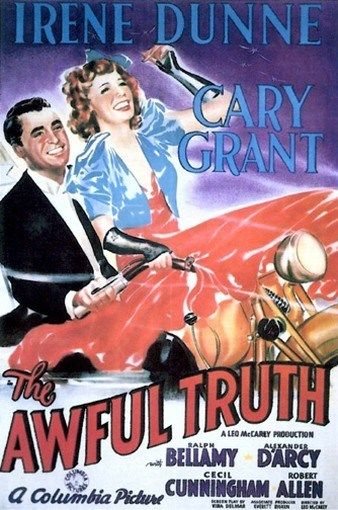
The Aweful Truth (1937)

This movie will be remembered as the first Cary Grant movie I ever picked up. Unlike his other classics, this movie doesn’t have a great story, but if one went back to the era of the 1930’s I am sure the theme of the film would have reflected the mood of many people, especially after their marriage.

 He stars as a husband who ends up having differences with his wife, played by Irene Dunne. The plot begins with the introductory scene itself and what happens later is a series of funny conversations and situations that kept me going till the end of the movie.

Cary Grant, who makes every attempt to ruin his wife’s future marriage prospects by continually interfering in her personal life while both wait for the divorce, played the role of a married bachelor to perfection.

Irene Dunne compliments the same to upset Cary’s prospects. Since I am a big fan of Cary Grant, I would say this movie was the first to showcase his comic persona, which became his trademark as he became a legend in the world of cinema.

This movie is about married couples, their differences, divorce, J factor, etc.

Released in 1937, The Awful Truth starring Cary Grant, Irene Dunne, Ralph Bellamy, to name a few, was voted as the best screwball comedies of the 1930s. This effort also won director Leo McCarey the best director Oscar.

For Fashion pundits, this movie is stylish concerning its outfits, especially the one worn by Irene Dunne in the first scene.