Countdown to the D-Day – Part III

I was quite superstitious about my hair. I just had too many things running on my head from mid-2007. It turned out to be excellent fodder for my hair. I just liked it, long hair; I took good care of it. It didn’t matter; I was working because I never had doubts I would cut my hair, owing to some pressure at work or family.

And people who mattered at work and home never pressurised me either. They knew I wouldn’t budge.

Actually, in a way, it turned out better. I was able to do a lot of work, which I enjoyed, meeting clients across Bangalore and Chennai. Ok, it was a coincidence that Dhoni, too, had long hair at that time. But who cares? He was successful, and often few people referred to me as Dhoni.

Coming back, March first week 2008, I flew to Mumbai for the zonal qualifying. We had four zones of qualifying Bangalore, Delhi, Mumbai, and Chennai. The top two teams are selected for the semi-finals in Mumbai, followed by finals very same day. After a nice lunch at Pradeep’s place, we reached the auditorium.

We didn’t qualify; it wasn’t about Formula 1 alone; it was about the entire Motorsports, which was something. We both were shocked, but to be honest, we weren’t disappointed. There was a lot of quality in the teams. We felt out of place at some times when we watched the finals.

We asked if we could take part in the Chennai round with the quiz master Avinash Mudaliar. Since we had not qualified, we were allowed to take part.

Boy, the next two weeks was to determine our capabilities. Pradeep just called at odd hours, and this time he was asking me to put fundas. Once, he even asked his girlfriend to speak to me about focussing on the task ahead and not waste time with girls and other stuff. He was funny, and I admire his unique ways of pushing his partner to achieve a common goal. He knew I had it in me.

We went to Chennai two weeks later, and guess what; it turned to be one of the most challenging motorsports prelims we had ever encountered. We topped the prelims again. It was the final round of qualifying, so in a way, we weren’t dished out Formula1, etc.; it was hardcore motorsports. All forms of Motorsports. We were introduced as one of the best Sports Quizzers by Avinash Mudaliar, quite sarcastic, though. We had a point to prove.

Till the last round, Man, we had lost it. There was no way we could make it, unless, for the miracles in the buzzer round. We had to answer three questions correctly and hope others answered them incorrectly or did not answer them at all.

This was to take the second spot.

The first question, we answer. The second question, the 5th team (a team which currently in second, answers), The third Question, the leading team answers. We still had a chance if we answered two correctly and hoped the last one went unanswered.

For the fourth question, a toughie, we press the buzzer and answer.

Hi-fi’s exchanged, c’mon, we can do it.

The fifth question, no clue, we press the buzzer, we worked out quickly, and Pradeep answered Bugatti. Perfect. We were 2nd. The last question went unanswered, as we didn’t have to take a chance.

We got a round of appreciation for our late effort. It was the final two rounds; we went overboard.

Ok, we made it. At least, the sarcasm proved we were good enough for the finals. Now, we were among the top eight teams in India, after a month round of qualifying.

We felt Barcelona a bit closer. Yes, the winning team won an all-expense trip to Spanish Grand Prix 2008. Pradeep, from the beginning, had one aim, Barcelona.

And in the end, it turned out; we did this quiz, travelling crazily one place after the other in search of this.

This was what one calls chasing one’s dreams—a dream of watching a Formula One event live.

That night, at Chennai Airport, I was reflecting on few things. I wondered, did my hair play any role?

I know; I was superstitious about it. I felt I had all the luck and got everything I wanted because I had long hair. I somehow didn’t like to be under this assumption.

I saw Dhoni winning in the Australia ODI series with his short hair. Sometimes, we need to break out of this shell to understand who we are. It’s good to be getting things done, not because of the hair, because of the capabilities.

Next few days, I went about pondering, to have a hair cut or not. Fine, let me have it. And I felt a change; I was not the same guy who went about being ruthless in his work; I thought I was reborn, and I knew I was transformed emotionally, and now I was ready to look at life from a different perspective.

Just a week before the finals, I had my hair cut. I feel one of the bold moves I ever made considering the stake of the finals. I didn’t want this hair; I wanted to get out of this, it was a sort of force holding me. I wanted to be liberated. Liberated I was after the haircut.

The finals were to be held at ITC Sheraton, Mumbai. All expenses for flight, hotel stay, transfers, etc., were paid by the Times of India and BP (Bharat Petroleum).

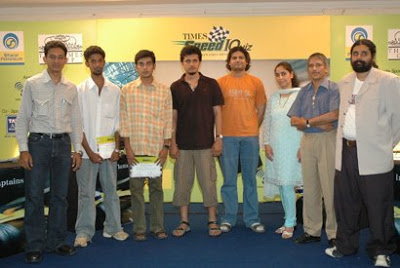
The Last Supper before the D-day

After watching Virender Sehwag getting to his second double hundred, I took the flight early morning to Mumbai. When I got out of the airport, I saw the score on my mobile phone. The message read, “Sehwag out for 319 and Sachin for a duck”.

We were taken to our hotel, Sea Princess, right next to Hotel Taj Mahal. The view from the room was terrific, Gateway of India adjoining to the sea face. A few months later, when I visited the same place for my Visa, it was carnage after the bomb blasts.

After having a nice lunch, I relaxed for a while. Pradeep, who stays in Mumbai, met me at the venue. We all had to wear sponsored T-shirts, and the Quiz Master was Derek O Brien.

It was a showcase event as the top management from B.P., Times of India had graced the occasion. Narain Karthikeyan was the special guest, and he did his bit like a quiz master towards the end. We managed to qualify for the finals by winning the semi-finals round. The scene was set for a grand finale. After a stage of some entertainment from Mansi Scott, we began the finals.

The finals were more of a game show than a quiz final. You had lots of unusual rounds. One team wasn’t performing and you had three teams going for the kill until the final round. We were one among the three.

Final round, we did our bit, two questions to go, we had lost the race for the top spot. The top two teams tied, and we were third-placed in the end. A college team from NIT Allahabad won the jackpot.

Wait, a minute, Second Prize gets an all-expense trip to Bangkok.

Third Prize, a lot of goodie bags, including Rs 6000 worth fuel, a small trophy, a chance to stand on the podium just like in Motorsports for prize distribution. The spray of champagne for winners and a group photo.

We knew we came close, and in hindsight, if it were to be out and out finals like it is usually conducted with scoring and other things, we would have won.

Nevertheless, it was some experience to be known as the third-best team in Motorsports Quiz in India. It was nice chatting with Narain Karthikeyan after the event for few minutes.

A few days later, this event was featured in the Bombay Times, and we had our picture on it. Looking back, it was March 29th last year, when we were verge of being Famous; it turned out we were ‘Almost Famous.’

I was fortunate, my partner was Pradeep, and I learned quite many things from him. It’s no joke, he was like a mentor, and I was happy to learn the tricks of the trade, which he had been for such a long time and continues to do. He taught me to calm the nerves before a big event, and we did pull each other legs during our so-called ‘Indian Sports Quiz Trip.’

To our team names ‘W.G. DisGrace’ to Mon-key (Mann ki) Shakti Tann ki Shakti (keeping with the theme of Harbhajan – Symonds incident), we did come a long way. In India, New Year begins around the last week of March. I can say it was a new year for me on a personal front. That was it, and it all ended in Mumbai. Quizzing terms, Yes. Personally, all the above experiences heralded the dawn of my new found life.

I had so much to tell that I ended up writing a blog in early April last year titled ‘Love story or is it my Story.’ The ramifications were such that it changed my life completely.

And April 6th was the D-day that soon turned out to be an important day of our lives. I know the events that occurred in those three months last year made me write a blog on my love life about a girl I never met, cut my hair, and start a new life.

In the end, the superstitious would have won; had I not cut my hair, we could have won. Who knows?

I don’t regret it. I am here in Switzerland writing this, a day after seeing Kimi Raikonnen losing out in Malaysia this year compared to him winning on April 6th at Bahrain last year. As the race culminated the previous year, I felt I was’ Out of my Comfort Zone’ for the first time in a week.

And that’s how it stands to date. A special friend did something ‘Out of her Comfort Zone,’ and since then, she has become extraordinary in my life, and so on we went about living the days of our lives.

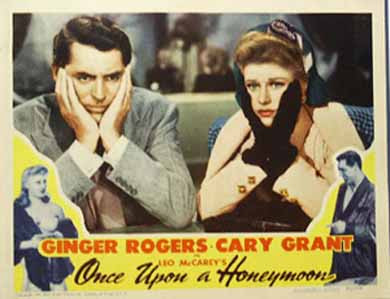
Once Upon a Honeymoon (1942)

During the time of WWII, many American reporters were deputed in Europe to narrate the war. This is a story of an American radio reporter Pat ‘O’ Toole, played by Cary Grant, his various adventures across Europe while covering the war. American burlesque Katie ‘O’ Hara marries an Austrian millionaire Baron Von Luber for her social climbing. Pat sees this marriage as an opportunity to expose the alleged, suspected ties of Baron with the Nazis.

Pat is after a story as he follows Katie and Baron on their honeymoon across many European countries. One can see country after country falling under the Nazi regime penned by Baron’s involvement.

Pat falls in love with Katie. Upon realising her husband’s role with Nazis, she escapes from the Baron by faking her death. When the Nazi regime had strengthened its hold in Europe, Katie, owing to her patriotic obligations, decides to don the role of a spy and goes back to Baron.

The final scene exposes the foolishness of Baron and the Nazi regime when Pat, upon agreement with Baron, delivers a radio speech to the public quite contrary to what was agreed upon.

This movie represents the typical Cary Grant, playing his comic – serious, eligible bachelor roles. Pretty looking, Ginger Rogers does justice to her role with her range of facial expressions and demonstrates her acting skills.

Look out for most actors’ comic timing as this film turned out to be just an entertainer. Keeping the mood of the early 1940s in America, this movie turns out to be another way of looking at WWII from an American perspective.

Released in 1942, Leo McCarey directs this comical adventure nominated for Best Oscar for sound recording.

The Roaring Twenties (1939)

‘The Roaring Twenties’ refers to the period post-WWI and the events during the 1920s in North America and other parts of Europe.

The recession hit America is not able to find jobs for the war veterans who return from Europe. Eddie Bartlett, George Hally, and Llyod Hart meet and become friends towards the war’s end.

Jean Sherman, played by Priscilla Lane, becomes a big fan of Eddie Bartlett for his heroics at war and sends him her photograph and letters during his stay in Europe.

Upon return to America, they find jobs hard to secure. Llyod Hart goes to practice law. George Hally, played by Humphrey Bogart, enters into bootlegging. The same would be Eddie Bartlett’s path, who becomes one of the members to have a bootleg business.

American prohibition law at that time prevented the manufacture, selling, import, and export of liquor. So this was taken as an opportunity to trade alcohol illegally.

He builds a fleet of cabs by selling bootleg liquors and hires Llyod Hart as his lawyer.

Eddie helps Jean Sherman to get a job in a speakeasy run by Panama Smith. Eddie is in love with Jean, and she is under obligation because of all the favours done to him.

The plot thickens when George becomes the partner and sets about killing the rival gang to regain supremacy.

Love debacle when it becomes clear that Jean Sherman and Llyod Hart are in love, his breakout with George and subsequent fall of share market doesn’t go well with Eddie. He spends some time in prison for his activities.

Eddie starts afresh by driving a cab, meets Jean Sherman after few years. Llyod Hart, happily married to Jean Sherman, has a home, a kid and a good work position. His life is under threat since Llyod is out to enforce specific legal laws that would ruin his business.

The final part is one of the defining moments when Jean Sherman asks Eddie to save her family. Eddie and George are having a confrontation resulting in gunshots and both being dead.

The character of Eddie Bartlett is inspired by the life and career of bootlegger Larry Fay. This movie also turned out to be one of the last action films James Cagney featured in before he set out to venture into other character roles.

Released in 1939, The Roaring Twenties was directed by Raoul Walsh. Look out for scenes where Humphrey Bogart and James Cagney share the space. It’s a viewer’s delight.

Suspicion (1941)

Travelling on a first-class compartment with a third-class ticket, Johnny Asgarth, played by Cary Grant, meets the shy Lina Mclindlaw essayed by Joan Fontaine. She is beauty personified, and Johnny uses every trick in the book to court her.

She comes from a wealthy background, a factor that drew Johnny towards Lina. Since no way she had to elope, her father, played by Sir Cedric Hardwicke, would approve their marriage. After a fantastic honeymoon, she discovers the mess Johnny is in. She feared for their future due to his reckless attitude and constant gambling tendencies.

Each time she feared, he used to calm her down with his charm. He was broke and in desperate need of money and engrossed himself reading many murder mysteries.

He had a good friend in Beaky, who did have money, and they had made plans to start a business. Beaky dies under mysterious circumstances, and Lina suspects her husband to have played a role in it. Her suspicion overrules her senses to an extent where she feels the tag of being the next target. She suspects Johnny to kill her and take the money from her insurance.

Her state of mind could be summed up with a scene where Johnny gets her a glass of milk. Interestingly, the scene is shot strangely. He holds the milk glass, which is glowing, and Lina feels the milk to be poisoned.

Fearing for her life, she decides to leave to her mother’s place, and Johnny hesitantly insists he would drive her.

(DISCLAIMER)

The movie’s highlight and probably the best scene are the last one as they drive along the road, with Johnny speeding up the car and moving close to the cliffs. Lina anxiously and fearfully expects her death, watches Johnny take a shortcut, and finds her door opened. He lends his hand to close the door; she feels he is trying to push her out. In the end, he manages to drag her back and stops the car.

He questions her behaviour and clarifies; he didn’t murder Beaky. Instead, he was reading murder mysteries to commit suicide as he was ashamed of his inability to pay off the debts and face prison.

As Lina, Joan Fontaine impresses with her acting skills, charm, and elegance in this movie. Cary Grant plays the role where there is love in the heart and trouble in his mind. A cameo from Alfred Hitchcock, where he is seen posting a letter in a post office scene.

This movie’s ending was altered to keep Cary Grant’s heroic image he had with the audience.

This film marked the first instance of Alfred Hitchcock producing and directing a movie. This also happens to be the only time he has directed an actor to an Oscar-winning performance. Joan Fontaine won the Oscar for Best Actress.

Besides, it was also nominated for Best Picture and Best Music.

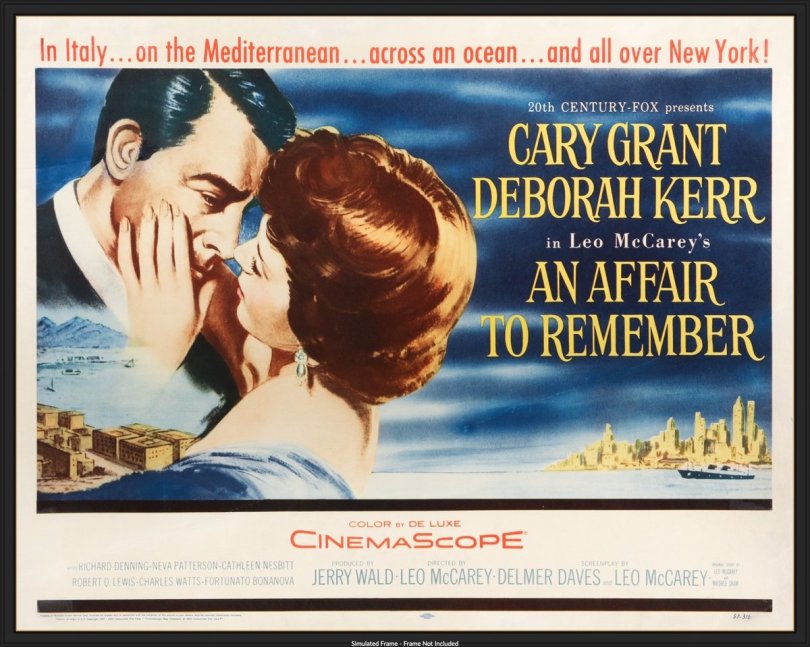
An Affair To Remember (1957)

What happens when a handsome playboy meets the gorgeous night club singer on a cruise. The first part of this Leo McCarey’s classic ‘An Affair to Remember’ showcases the above scenario. Cary Grant as Nickie Ferrante plays the playboy, and Deborah Kerr plays the dashing Terry Mckay.

Despite both being engaged, they couldn’t help themselves falling in love with each other on the ship and make a promise to meet after six months at The Empire State Building.

With engagements being on hold, both wait for six months to see each other on the building’s 102nd floor. A perfect story in progress until Debroah Kerr meets with an accident right on the day of the visit. Cary Grant striding to and fro on the 102nd floor, can only console himself. He waits the entire day and wonders why till the end of the movie.

Whether they would get married would remain unanswered, and accident becomes the reason that prevents the reunion of the couple.

The story was quite a drama back then, not the same as when it was made in Hindi in 1999. One can copy the theme, not the entire storyline and scene settings. ‘Mann’ starring Aamir Khan and Manisha Koirala, failed because it couldn’t connect to the so-called “modern-time” and not compelling content. Times change, hence individual perceptions on love change. Unfortunately, Mann wasn’t able to accommodate this change.

The highlights are the scenes shot in a garden mansion where Cary Grant takes Deborah Kerr to meet her grandmother. Their love blossomed at the very place. The last scene is a memorable one when Cary Grants holds Deborah Kerr.

This movie is a remake of the 1939 film ‘Love Affair’ starring Irene Dunne and Charles Boyer. Leo McCarey directed both.

An Affair to Remember was nominated for four Oscars in the Best Music, Best Costume, Best Song, and Best Cinematography categories.

Notorious (1946)

Cary Grant and Ingrid Bergman’s on-screen romance was seen for the first time in Alfred Hitchcock’s thriller ‘Notorious.’

This film is highly rated for its screenplay. Some of the scenes involving Cary Grant and Ingrid Bergman were breathtaking, the famous being the on/off again kiss scene, the scene was shot in compilant with the Hayes code, that prevented a kiss scene from being no more than three seconds.

Alicia, the character of Ingrid Bergman, plays an undercover agent to the US Government to repay the moral debt. This was for the spying activities of her father. Her father was a German spy, and he ends his life committing suicide while in prison. The Government agent, T.R. Devlin, played by Cary Grant, carries out a mission to trap other spies, most notably Sebastian.

Most of the movie is shot in Brazil, where Sebastian (Claude Rains) and his other partners in crime are operating their mission. A top-secret project under a Wine Manufacturer’s name. The story unfolds with Ingrid Bergman playing the undercover and helping the US Government uncover Sebastian and Co’s malicious intentions. One can also see ‘Christ the Redeemer,’ one of the current seven wonders at Rio in the movie.

Alfred Hitchcock’s cameo comes during the party at Sebastian’s house. The director is having a drink.

Watch out for the final scenes where an intoxicated Bergman has some of the movie’s most refined lines. Cary Grant, unusually not with his humour wit, displays an angry look in the entire film.

Its such a rarity that one cannot see him smile still manages to pull off romantic scenes with such ease and guile.

This 1946 movie was nominated for two Oscars in the Best Supporting category for Claude Rains and Best Story (Original Screenplay).

Rope (1948)

The narration of a movie based on a ‘prop’ is interesting. This movie happens to be the first ‘Alfred Hitchcock’ movie in colour. The film was shot in a single set; this movie throws up many exciting scenarios and a series of long takes. This movie is loosely based on a real-life murder committed by University of Chicago students known as the Leopold & Loeb case.

The movie stars James Stewart as Rupert Cadell. Superior vs. Inferior’s debatable theory is the theme, and the whole film revolves around the hideous intentions being masked by this theory.

James Stewart has the final say and, in his way, explains while being ashamed of his theory ‘Superior vs. Inferior.’

Hitchcock doesn’t make a live cameo; instead, his profile on a neon signboard outside the window. Apart from James Stewart, John Dall as Brandon Call, Farley Granger as Philip Morgan are the movie’s main characters. Dick Hogan as David Kentley is the subject around which the film unfolds.

Sir Cedric Hardwicke makes an appearance for a while as David’s father. Joan Chandler completes the movie cast of a young actress missing the list.

(DISCLAIMER) The story is about a young student named David Kentley being strangled by a ‘ROPE’ by his friends Brandon Call and Philip Morgan. The reasons are not known and are not a matter of concern as far this movie goes. The only point was the intellectual superiority.

The body is hidden inside a chest where supposedly books were meant to be kept. Brandon hosts a party at his place to ensure everything is normal. He makes a mistake by inviting Rupert Cadell, who unveils the mystery when David’s absence in the party raised many concerns.

The movie was an adapted version of the same title in 1929 by Patrick Hamilton.

Released in 1948, the movie Rope was one of Hitchcock’s ‘Infamous five lost’ movies.

The Purpose Defeated

As I am preparing to sleep with music on, the whole point of this blog was unfruitful. I watched the movies because I wanted to watch them.

Never mind the delay in watching them, I can safely say I have made up for the loss. I am not 50 years old, and I am happy that cinema’s legacy as a cinephile, which my grandfather, my mother, and her sisters, brothers had, will continue through me.

I would say I have been in a mood to watch anything that people call ‘Old,’ ‘Dull,’ ‘Black ‘n’ White,’ ‘Old Actors,’ ‘Uncool,’ etc. These are, of course, gone on to become so-called ‘Classics.’

The best way to know actors, actresses, directors, writers are to experience their works, very similar to appreciate a musician by listening to his/her piece of work. My likes or dislikes will be a perspective. And to be honest, I can only influence a few, not create a revolutionary opinion.

This blog was meant to touch up the movies I have been watching, and it’s been a long time… I regret this; the purpose is defeated.

To the future, for the unregretful moments……… Till I call it ‘cut(s),’ instead of quits’

In India, is Cricket the lone Survivor?

As an avid fan of cricket, sometimes I am happy with India’s situation financially and can build an ever-evolving cricket team that competes well abroad and at home.

Apart from occasional debacles (like losing a series to home or early exit at premier tournaments), our team has done well; this includes the Women’s cricket team.

It’s a welcome note to have included women’s cricket as a part of ICC, and in India, BCCI finally managed to take it under its reins. It’s something good for the game of cricket in the years to come. Now cricket has reached a stage; it plans to be an Olympic Sport in 2020 or 2024. It’s a significant step.

Trust me, an Olympic Sport always gets recognised worldwide, and it is one of the best ways to promote the game on a global scale. Knowing IOC, it’s a challenge to change their Euro-centric views about cricket and its reception by other member nations.

In India, we have IPL and ICL entangled in legal battles. It’s sad, but this also brings to an important point. Can’t we ensure other games like Hockey, football, basketball, etc., to be promoted in a franchise model? Boxing is being under consideration, and the two bronze medals at Beijing are a positive result and will see more people support Boxing in the coming years.

In India, the Economy and social life are often associated with Indiviual Sports’ shaping up. At present, we have to admit; we don’t have a culture for Hockey or football. People play cricket instead.

It’s not a lack of players who are willing to play Hockey; it’s the case of people who opt for cricket. The same is with football or other sports in India. The surroundings and social structure have played a significant role. And this has an impact on the economics of Sports. We are a billion people; few people can give us hope but cannot change the current situation.

A few years back, PHL (Premier Hockey League) kicked off grandly, and this was even before the idea of IPL (Indian Premier League) or ICL (Indian Cricket League) got materialised.

It ran for three years before it lost its charm. Why? A lot of reasons. I am not going into that aspect.

Instead of spending millions of dollars on ex-cricketers, current cricketers, future stars, the legal fees, why don’t Zee Sports (the idea behind ICL) look to terminate the idea about making money through cricket. It was a great idea, but sadly we have a powerhouse in BCCI. Why fight when you cannot win and can win through other sports?

If Zee Sport aims to create athletes in cricketers, why don’t they focus on non-cricketers, who need media attention, who needs funding where they feel good and perform. Why don’t they create an even playing ground for other sports?

If I were to be Subhash Chandra, I would utilise this opportunity to look at Hockey, football, and other Sports and create a social culture in which other athletes can become champions.

To be a catalyst and help the public accepting other sports by creating a scenario where games can stand on their merit, not just for sympathy reasons.

It’s a win-win situation in the long term. India as a Sports Nation can benefit; corporates can look for alternatives if they find cricket an expensive way of advertising. And finally, Zee can win the so-called ‘personal battle’ with BCCI. Leave cricket to BCCI; they are doing an excellent job of it. Concentrate on other sports.

The reality is, I am not Subhash Chandra, and I am just expressing my thoughts as an extension of various discussions on the state of Olympic Sports in India with other students from different parts of the world in the Olympic Capital.